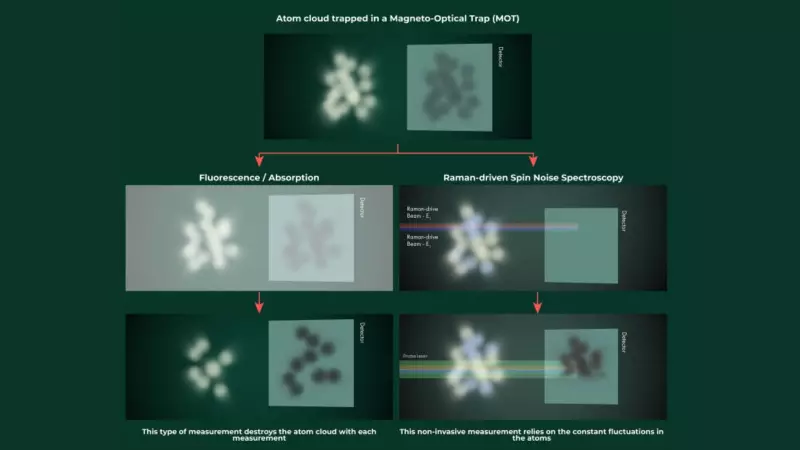
In a significant leap for quantum research in India, scientists at Bengaluru's Raman Research Institute (RRI) have unveiled a groundbreaking, non-invasive method to measure the density of atoms in quantum systems. This gentle technique, which preserves the delicate states crucial for quantum technologies, could accelerate the practical development of quantum computers and ultra-sensitive sensors.
The Challenge of Observing Quantum Systems
Modern quantum experiments often rely on clouds of atoms cooled to temperatures near absolute zero. In this extreme cold, atoms slow down enough to exhibit quantum properties useful for neutral-atom quantum computers and devices like gravimeters and magnetometers. However, observing these atoms has always been a major hurdle. Traditional measurement methods often disrupt the very quantum states researchers aim to study. Techniques like absorption imaging struggle with dense atomic clouds, while fluorescence imaging can require disruptive, high-power light that heats or scatters the atoms.
A Softer Approach: Listening to Atomic Whispers
The RRI team, led by scientists under India's National Quantum Mission, has demonstrated a novel solution called Raman Driven Spin Noise Spectroscopy (RDSNS). Instead of aggressively probing the atoms, this method 'listens' to their natural behavior. It detects minuscule, inherent fluctuations in the spins of atoms. As a weak laser beam passes through the atomic cloud, these spin fluctuations subtly alter the light's polarization. By meticulously analyzing these changes, researchers can infer local atom density without directly perturbing the system.

The key innovation lies in signal amplification. The team used two additional laser beams to gently drive atoms between neighboring spin states, boosting the detectable signal by nearly a million times. This allowed them to focus on an exceptionally small region, probing a volume of about 0.01 cubic millimetres containing roughly 10,000 atoms, using a probe beam just 38 micrometres wide.
Revealing Hidden Local Dynamics
When applied to potassium atoms in a magneto-optical trap, RDSNS revealed insights that global measurements missed. It showed that density at the cloud's centre peaked in about one second, whereas fluorescence-based measurements of the total atom count continued rising for nearly twice as long. This highlights RDSNS's unique ability to capture fast local dynamics critical for understanding quantum systems.
The method is effectively non-invasive because the probing light is kept at low power and tuned away from the atoms' natural resonance. It delivers reliable results on microsecond timescales, making it ideal for tracking rapid changes. The team validated its accuracy by comparing RDSNS data with mathematically reconstructed density profiles from fluorescence images, confirming its precision even when traditional assumptions about symmetry break down.
Broad Implications for Quantum Technology
The implications of this research are extensive. Accurate knowledge of atom density is fundamental for the operation of quantum devices like gravimeters and magnetometers. Furthermore, RDSNS provides a new tool to experimentally study the transport properties of quantum matter by examining density fluctuations with high sensitivity. This positions the technique as a potential fundamental tool in translating quantum theory into practical, working technology.
This work underscores a powerful concept in quantum science: to truly understand the quantum realm, sometimes the best approach is not to look harder, but to look more softly. The support from the National Quantum Mission highlights India's growing capabilities and strategic focus in this cutting-edge field of science and technology.