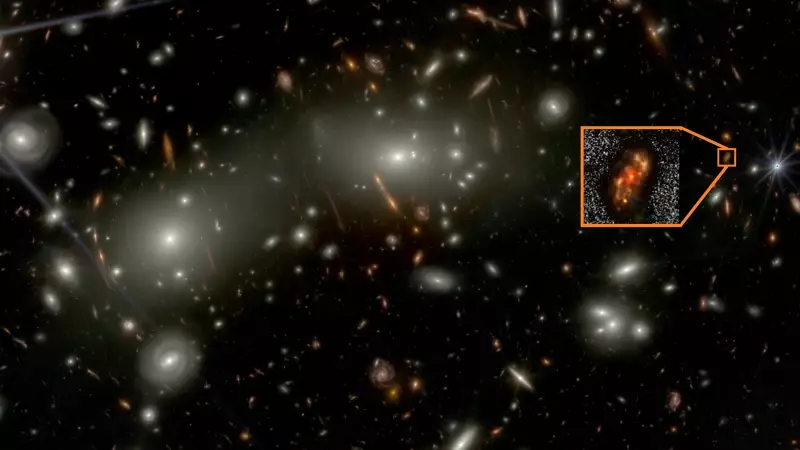
In a groundbreaking discovery that challenges our understanding of cosmic evolution, researchers from Pune have identified a remarkably well-structured spiral galaxy that existed when the universe was in its infancy. The galaxy, named Alaknanda, was observed as it was when the universe was merely 1.5 billion years old, making it one of the earliest such structures ever seen.
A Textbook Spiral Defying Expectations
The discovery, led by PhD student Rashi Jain under the guidance of Professor Yogesh Wadadekar at the National Centre for Radio Astrophysics (NCRA-TIFR) in Pune, was published in the prestigious journal Astronomy and Astrophysics. What makes Alaknanda extraordinary is its textbook spiral structure, featuring two well-defined arms wrapping around a bright central core, spanning about 30,000 light-years in diameter.
This finding is unexpected because, according to prevailing scientific models, galaxies from this early epoch—just 10% of the universe's current age—should be chaotic, turbulent, and lacking clear form. "Finding such a well-formed spiral galaxy at this early epoch is quite unexpected," Jain stated. "It tells us that sophisticated structures were being built in our universe much earlier than we thought possible."

The Power of James Webb and the Naming of Alaknanda
The pivotal observations were made using NASA's James Webb Space Telescope (JWST), the most powerful observatory ever launched into space. Since its deployment in December 2021, JWST has consistently provided data reshaping cosmic history, including spotting some of the oldest known galaxies.
The researchers chose the name Alaknanda with poetic significance. "Alaknanda is a spiral galaxy located about 12 billion light-years away," explained Jain. "Just as the Alaknanda river is the sister to the Mandakini river—which is also the Hindi name for our own Milky Way—we thought it fitting to name this distant sister after the Alaknanda river."
Implications and Future Research
Professor Wadadekar emphasized that Alaknanda adds to growing JWST evidence suggesting the early universe was more mature and evolved faster than previously believed. The next phase of research will focus on studying the motion of gas and stars within Alaknanda. "Depending on whether the motion is regular or chaotic, we will get clues about the mechanism that formed the spiral arms," he said.
Further investigations will combine data from JWST and the ALMA telescope in Chile. These studies aim to determine if galaxies like Alaknanda represent a unique evolutionary pathway that existed in the early cosmos, potentially rewriting chapters in the story of galaxy formation.