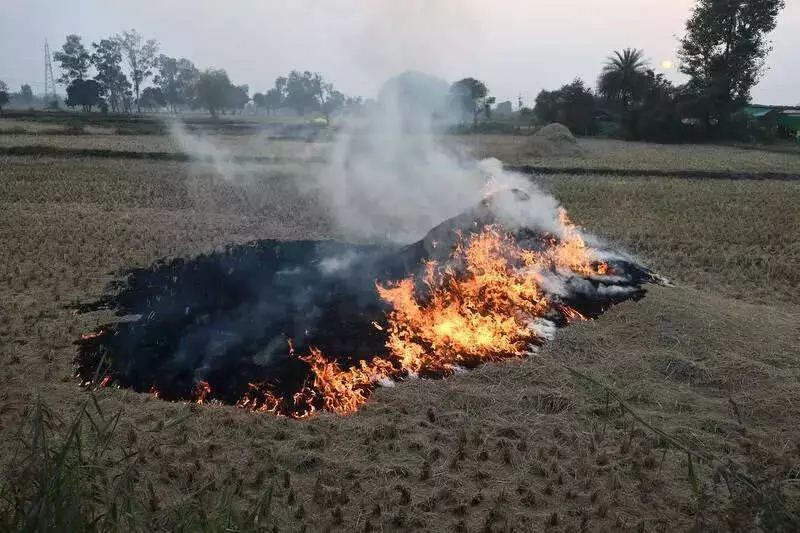
In a landmark move that could tackle two major challenges at once, scientists in India have perfected a method to convert the agricultural waste that chokes Delhi's air every winter into a durable material for building roads. This innovative bio-bitumen technology, developed by the CSIR-Central Road Research Institute (CRRI), promises to turn a seasonal pollution crisis into a sustainable solution for infrastructure.
A Historic Technology Transfer
The project reached a critical commercial milestone on Wednesday when the technology was formally handed over to 14 companies. The transfer ceremony, titled "From Farm Residue to Road: Bio-Bitumen via Pyrolysis," was attended by Union Minister for Road Transport and Highways Nitin Gadkari and Union Minister Jitendra Singh.
Minister Gadkari hailed the occasion as historic, declaring, "Today marks a historic milestone, as India becomes the first country in the world to commercially produce bio-bitumen." He emphasized the technology's vast potential and recommended maximizing the use of farm waste. Gadkari also noted his intent to guide collaboration with the Indian Roads Congress (IRC) once the material receives BIS certification.

From Pollution to Paving: The Science Behind It
The journey began in 2021 when CRRI scientists G Bharath and Ambika Behl asked a pivotal question: could Delhi's pollution problem be part of its own solution? They focused on stubble burning—a primary cause of the capital's winter smog—and started experimenting with converting this waste.
In collaboration with CSIR-Indian Institute of Petroleum, the team spent three years refining a straightforward process. Rice straw is collected from fields, compressed into pellets, and heated in a low-oxygen environment through pyrolysis to release bio-oil. This bio-oil is then blended with conventional bitumen, partially replacing the petroleum-based material.
The resulting bio-bitumen mix performs as well as, or even better than, traditional bitumen, resisting cracks, potholes, and extreme summer heat. The first trial road using this material was laid in Meghalaya in 2024. "This stretch has faced two monsoons and still maintains highway quality," confirmed an official associated with the project.
Economic and Environmental Impact
The benefits of this innovation are twofold. Environmentally, it offers a constructive outlet for agro-waste, curbing the harmful practice of stubble burning and strengthening the circular economy. Economically, it reduces dependence on imported crude oil.
"With just 15% blending, India can save nearly Rs 4,500 crore in foreign exchange and reduce reliance on imported crude oil," Minister Gadkari stated. He also stressed the need for location-specific research based on raw material availability.
Scientists highlight that the technology is both cost-effective and easy to adopt. "The beauty of this technology is that it works with the machinery we already have. You don't need to reinvent the wheel to lay a bio-bitumen road," said scientist G Bharath, adding that bio-bitumen is cheaper than its traditional counterpart.
The immediate plan is to approach the Delhi government within the next two months to pilot bio-bitumen on key arterial roads. The broader goal of the technology transfer is to build nationwide capacity, enabling more companies to produce and lay these sustainable roads. All roads built with this mix already meet BIS standards, and researchers are working with IRC to encourage at least a 10% replacement of conventional bitumen, with the potential to go up to 30% based on feedstock availability.