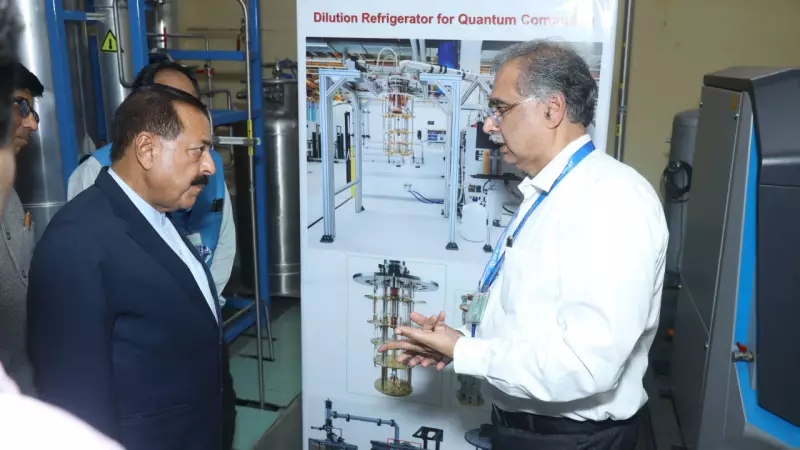
In a significant move to bolster India's technological capabilities, Union Minister Jitendra Singh announced the establishment of four state-of-the-art quantum fabrication facilities with an investment of Rs 720 crore. The announcement came during his visit to IIT Bombay on Wednesday, marking a pivotal moment in India's quantum technology journey.
Quantum Infrastructure Distribution Across Premier Institutes
The massive investment under the National Quantum Mission will be distributed across three IITs and the Indian Institute of Science. IIT Delhi, IIT Bombay, IIT Kanpur, and IISc Bengaluru will host these advanced facilities that promise to transform India's quantum technology landscape.
Minister Singh emphasized that these facilities represent a decisive leap toward technological sovereignty, positioning India among select global leaders in next-generation quantum technologies. The fabrication and characterization capabilities will span multiple quantum domains including quantum sensing, quantum computing, and quantum materials.

Specialized Roles and National Access
Each institution has been assigned specific roles in the national quantum ecosystem. IIT Bombay and IIT Kanpur will anchor the nation's quantum sensing and metrology infrastructure, while IISc Bengaluru and IIT Bombay will advance quantum computing fabrication using superconducting, photonic and spin qubits. IIT Delhi will host India's quantum materials and device development ecosystem.
These facilities will serve as the foundational hardware ecosystem needed to build sovereign, secure, and scalable quantum devices and systems within the country. Importantly, the minister confirmed that these facilities will be open not only to NQM investigators but also to academia, industry, startups, and strategic sectors across India.
Broader Impact and Existing Success Stories
The quantum capabilities will create controlled environments for prototyping indigenous quantum devices, supporting translational research, and training the next generation of quantum hardware experts. Minister Singh drew parallels between these new facilities and India's space achievements, suggesting they will become similar national pride assets that elevate global esteem for Indian youth and scientists.
Highlighting IIT Bombay's existing Technology Innovation Hub under the national mission on interdisciplinary cyber-physical systems, Singh noted it has become a national model for translational research. The hub currently supports 96 technology development projects and more than 50 deep-tech startups, with 23 portfolio companies already generating revenue and achieving a combined valuation of Rs 466 crore.
The minister concluded that the National Quantum Mission, NM-ICPS, and BharatGen collectively represent India's bold strides toward a future defined by deep-tech leadership, knowledge sovereignty, and Atmanirbhar Bharat, ensuring the nation doesn't miss the quantum technology revolution.