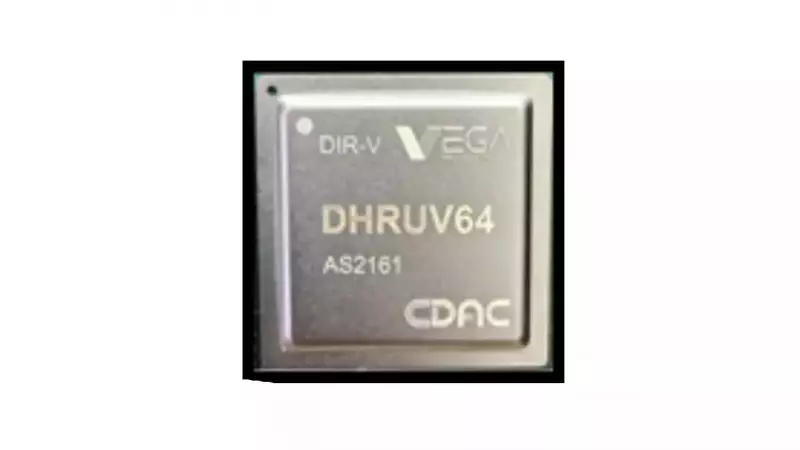
India has taken a giant leap towards technological self-reliance with the successful development of its first fully homegrown, high-performance microprocessor. Named DHRUV64, this chip represents a national milestone in semiconductor design and strategic electronics.
What is DHRUV64 and Why It Matters
The DHRUV64 is India's inaugural indigenously developed 1.0 GHz, 64-bit dual-core architecture microprocessor. This critical piece of technology, often called the "brain" of electronic devices, was created by the Centre for Development of Advanced Computing (C-DAC) under the government's Microprocessor Development Programme (MDP). Its development signifies a major step in reducing India's dependency on foreign semiconductor suppliers for both commercial and strategic needs.
Given that India consumes roughly 20% of all microprocessors made globally, having a reliable domestic source is crucial for national security and economic stability. The DHRUV64 is engineered to provide that reliable, fully indigenous processor technology.

Key Features and Potential Applications
Built with modern architectural features, the DHRUV64 microprocessor is designed for higher efficiency, superior multitasking, and enhanced reliability. It leverages advanced fabrication technologies, allowing for easy integration with a wide array of external hardware systems.
The microprocessor is versatile and suited for multiple high-growth sectors:
- 5G Infrastructure: Supporting the backbone of next-generation communication networks.
- Automotive Systems: Powering modern vehicles and electric mobility solutions.
- Consumer Electronics: From smart devices to everyday gadgets.
- Industrial Automation: Driving robotics and automated manufacturing processes.
- Internet of Things (IoT): Enabling smart cities and connected devices.
Joining an Expanding Family of Indian Processors
The DHRUV64 is not a standalone achievement but the latest member of a growing family of processors developed within India in recent years. This lineage showcases the country's sustained commitment to building its semiconductor ecosystem:
- SHAKTI (2018): Developed by IIT Madras, focusing on strategic, space, and defense applications.
- AJIT (2018): Created by IIT Bombay for use in industrial and robotics applications.
- VIKRAM (2025): Engineered by ISRO–SCL to withstand the extreme conditions of space.
- THEJAS64 (2025): Also from C-DAC, designed specifically for industrial automation.
The momentum is set to continue. C-DAC is already advancing its work on the next generation of RISC-V processors, named Dhanush and Dhanush+ SoCs. These future systems-on-chip are expected to further broaden the spectrum of indigenous options available for India's strategic and commercial sectors.
The launch of DHRUV64 is more than a technical accomplishment; it is a foundational step towards securing India's digital future and asserting its sovereignty in the critical domain of semiconductor technology.