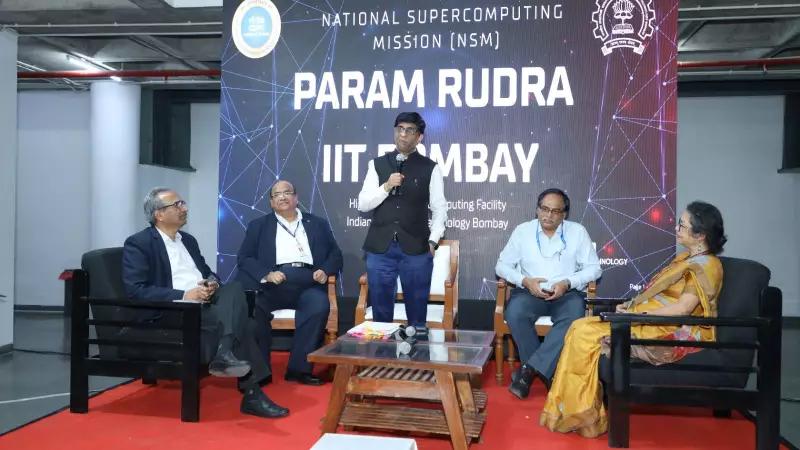
In a significant boost to India's scientific and technological prowess, the Indian Institute of Technology (IIT) Bombay has officially launched a powerful new supercomputing facility named PARAM Rudra. The facility was inaugurated on January 9, 2026, by Professor Abhay Karandikar, Secretary of the Department of Science and Technology (DST).
A Milestone in Indigenous Supercomputing
Developed and deployed by the Centre for Development of Advanced Computing (C-DAC) under the National Supercomputing Mission (NSM), PARAM Rudra represents a leap in homegrown high-performance computing (HPC). The system boasts a formidable processing power of three Peta FLOPS. It is built on indigenously designed Rudra servers that are manufactured within India, showcasing the nation's growing self-reliance in critical technology.
The supercomputer is powered by C-DAC's own software stack and utilizes advanced Direct Contact Liquid Cooling (DCLC) technology for superior energy efficiency and performance. This setup is a result of the NSM's 'Build Approach', which focuses on creating domestic capability.

Empowering Research and Industry Collaboration
In his address, Professor Abhay Karandikar emphasized that PARAM Rudra will be a cornerstone for computational research. It is expected to directly benefit over 200 faculty members and 1,200 students at IIT Bombay, along with researchers from across the country. The facility is strategically positioned to accelerate innovation in frontier areas including Artificial Intelligence (AI), Biotechnology, and Advanced Manufacturing.
Furthermore, the supercomputer will provide crucial support to startups and industry-driven research, fostering a stronger link between academia and the commercial sector. Dr. Hemant Darbari, NSM Mission Director, noted that the facility will also augment research prospects for several institutions in and around Mumbai, enhancing collaborative scientific outcomes.
Scaling India's Supercomputing Ambitions
The addition of PARAM Rudra marks a key step in the National Supercomputing Mission's roadmap. Dr. Darbari announced that with this commissioning, 38 supercomputers with a cumulative capacity of 44 Peta FLOPS have now been deployed nationwide under the NSM umbrella.
Sunita Verma, Group Coordinator at the Ministry of Electronics and Information Technology (MeitY), highlighted that the Rudra-based cluster is a major milestone in India's indigenous supercomputing journey. She stressed the importance of continued investment in HPC systems, software, microprocessors, and networking to advance towards the next goal of exascale computing.
The NSM is a joint initiative steered by MeitY and DST, with C-DAC and the Indian Institute of Science (IISc) Bengaluru as the implementing agencies. The mission is built on four pillars: creating supercomputing infrastructure, developing applications, fostering research and development, and building human resources, aiming to establish a comprehensive and self-sufficient HPC ecosystem in India.