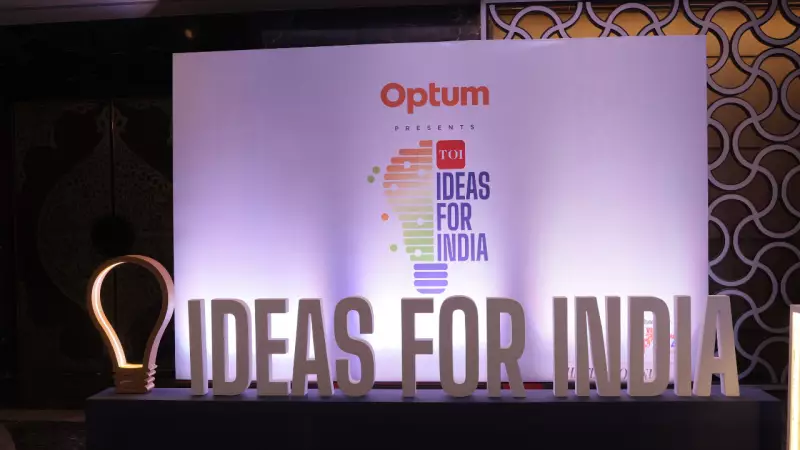
Ideas for India Summit Turns Problems into Actionable Missions
At the TOI Ideas for India summit, everyday challenges transformed into urgent missions. The nationwide Innovation Challenge moved beyond mere talk. It actively empowered students, technologists, and changemakers to build scalable, real-world solutions.
Presenters Unfold Realities with Passion and Precision
One by one, presenters stepped forward. They unfolded stark realities of broken systems and presented sharp business models. Charts, sketches, and prototypes filled the room. Each idea offered a clear lens into challenges millions face daily.
The jury, a formidable panel of seasoned professionals, listened intently. After every presentation, they leaned forward with a grounding question: "How will this actually work on the ground?"

Rigorous Scrutiny and Passionate Defense
Cross-questions flew fast. The jury probed scalability, field conditions, cost, local acceptance, and overall feasibility. Innovators held their ground firmly. They answered with a passion forged by years of firsthand experience with the problems they aimed to solve.
All submissions fell under three core pillars: Make in India for the World, Environmental Sustainability, and Health & Social Well-being.
Spotlight on Environmental and Health Innovations
The focus shifted from road safety to real-time environmental accountability. Rajeev S Hundekar, founder of Preusse Powertrain Innovations, posed a chilling question. "The count is 60 — can anyone guess?" He revealed the answer: "Deaths due to pollution in the last 10 minutes."
His winning solution in the Environment & Sustainability–Tech category tackles this head-on. It is a high-speed centrifugal supercharger system. This technology reduces emissions during acceleration, improves combustion, and upgrades the performance of existing internal combustion engine vehicles. The innovation is backed by six patents.
Juror Piyush Doshi from The Convergence Foundation highlighted the event's spirit. "We often assume big companies hold all the expertise. But then you meet innovators like these — full of optimism and problem-solving. Support them early, and you never know who might become the next Ritesh Agarwal."
Compact Solutions with Massive Impact
In another session, Rohit Shah won in the sustainability category. He held a deceptively small device, shaped like a mobile phone. His Plug & Play Mobile Water Purifier rethinks how India drinks water on the move. It eliminates the need for plastic bottles.
"It can purify any tap water in minutes without losing essential minerals or wasting water," Shah explained during a live demonstration for the jury.
For many jurors, the standout quality was not just ingenuity. It was the persistent drive and deep personal experience behind each solution.
A Diverse and Refreshing Pool of Ideas
By the summit's end, a shared sense emerged. This was only the beginning. The diversity was striking — from student-led projects to experienced teams tackling healthcare and assistive technologies. This made the innovation pool "especially refreshing," with several entries naturally rising to the top.

The Winning Ideas That Stood Out
Economic Resilience
- Tech: Vishal Sanghvi's TRIPonist — A 499 rupee ear/wrist-mounted device that detects head-nods to prevent road accidents caused by drowsiness.
- Beyond Tech: Dr. Jayanti Prasad Nautiyal's High Farming-High Income — Tall, high-yield crop varieties grown on ridges and unused land to maximise agricultural output.
Environment & Sustainability
- Tech: Rajeev S Hundekar's high-speed centrifugal supercharger system for reducing vehicle emissions.
- Beyond Tech: Two winners: Jenil Gandhi & Manan Vyas's Avingya Vegan Leather made from crop residue, and Rohit Shah's mobile water purifier.
Health & Social Causes
- Tech: Chinmaya Naik's BlisCare — A digital Braille display tablet that converts text and diagrams into Braille for visually impaired learners.
FM Nirmala Sitharaman's Vision for a $10 Trillion Economy
Finance Minister Nirmala Sitharaman sent a powerful message. "India's path to a $10 trillion economy will be decided by the quality of our ideas and the seriousness with which we execute them."
She reflected on India's historical burdens and post-Independence struggles. Today's task, she stated, is different. It demands broad-based growth that is geographically even, socially inclusive, and sustainable.
"Sustainability is not a borrowed concept for India; it is inherent to our way of life," she asserted. The challenge now is scaling that mindset through green tech and circular-economy practices. "Our development path will be Indian, not an imitation of the Western model."
She commended the Times of India Group for the 'Ideas of India' initiative. Such programmes, she said, provide possible pathways for the journey towards a Viksit Bharat by 2047.
Industry Leaders on India's Competitive Edge
A key session concluded that the next big shift for economic growth is moving from digital public infrastructure (DPI) to AI-led infrastructure.
Puneet Chandok, President of Microsoft India and South Asia, called India one of the world's most exciting tech markets. "The big unlock is when we move from DPI, a fantastic foundation, to AI-driven infrastructure. This allows a billion Indians to leverage AI across the country."
Sanjeev Bikhchandani, founder of InfoEdge, highlighted the democratising power of startups. He noted their emergence from tier 2 and 3 cities, beyond traditional business families. "The giants of tomorrow will come from startups of today," he asserted.
Uma Ratnam Krishnan, MD of Optum, identified healthcare as a clear opportunity. "India can combine clinical talent with AI to export cost-effective care models," she said. She pointed to scale-tested solutions, proven governance, strong talent, and a rich healthcare data environment as key strengths. "This underpins our global competitiveness."