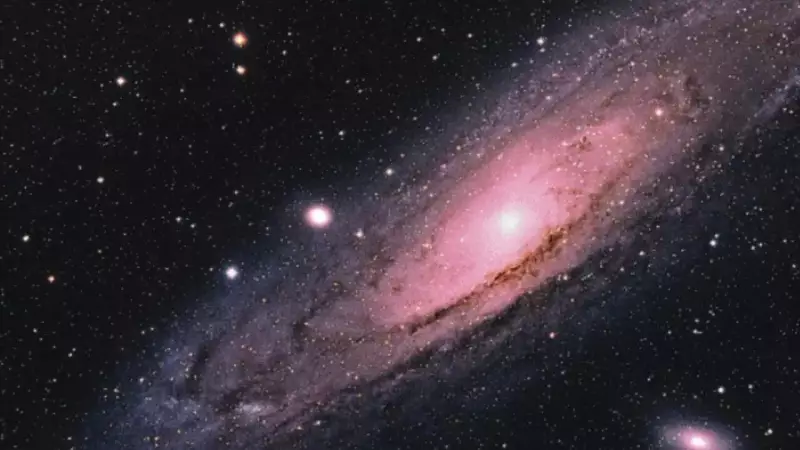
When Satish Ponnala tells people in Hyderabad about his hobby of photographing galaxies from his home, he often faces skeptical questions. "Why spend lakhs when you can download images from the internet?" or "Doesn't the Hubble telescope already do that?" are common reactions. Yet, Satish, a veteran with over two decades in the software industry, spends his nights meticulously capturing light that has travelled millions of years from objects like the Southern Pinwheel Galaxy.
The Steep Price of Peering into the Cosmos
Astrophotography is an expensive pursuit, especially as a hobby. Experts indicate that a basic, capable setup—known as a smart rig comprising a telescope, camera, tracker, tripod, and other precision components—can easily cost between Rs 6 to 7 lakh. For those venturing into advanced territory, the investment can skyrocket past Rs 50 lakh. This high barrier to entry explains why India's community of deep-sky imagers is tiny: only a handful in Hyderabad and a few hundred across the entire country who regularly practice.
The financial burden is exacerbated by India's import duties and taxes, as most high-end equipment must be sourced from the US, UK, or increasingly, China. Daraesh Parvez Mistry, a Secunderabad-based Chief Technology Officer, recalls buying his first smart telescope from the US a decade ago for Rs 2 lakh. His collection has since grown to seven telescopes and various components like eyepieces and filters, representing a total investment of roughly Rs 30 lakh.

A Test of Patience and Perseverance
For enthusiasts like Upendra Pinneli, a marketing head for an EV startup, astrophotography is a meditative process. The preparation begins hours before nightfall, involving the delicate handling and alignment of heavy equipment. "This is when I am completely immersed in the process," he says.
The actual imaging requires immense patience. Capturing faint deep-sky objects (DSOs) like nebulae and distant galaxies can take anywhere from a few hours to over 30 hours of exposure time. Satish explains the extensive workflow: "We spend one or more nights shooting a single DSO and then days on post-production." This involves stacking multiple images of the same object to enhance detail, a painstaking but rewarding task. "I've been able to photograph clusters which contain thousands of galaxies," he shares.
For sales professional Tarun Pulikanti, the reward is in the progression. He has been imaging the Orion constellation for seven years, refining his picture at least ten times. "It's the progression that matters. It gives you a lot of ROI in terms of satisfaction," he notes.
Battling Urban Skies and Satellite Trails
The pursuit is governed by factors beyond an astronomer's control: weather, moonlight, and severe light pollution. Hyderabad's skies are rated close to Bortle Class 9, the brightest level on the light pollution scale, which washes out celestial details. Winters offer the best conditions, but imaging is impossible for a week before and after a full moon due to excess light.
Even with a perfect forecast, luck plays a role. Upendra, a landscape astrophotography specialist, recounts, "At times, I've travelled 200km only to return without a single click." Furthermore, the increasing number of artificial satellite clusters launched annually often streaks across and spoils long-exposure images.
To combat city lights, amateurs like Syed Vilayath Hussain invest in additional gear. "I'm planning to buy specific filters for one of my rigs to reduce the effects of city light. That's another Rs 1 lakh," he says. Syed also highlights a market shift: "China is now making top-tier astronomy equipment at one-third the price of Western countries," expressing hope that India too will start manufacturing advanced gear.
The Irreplaceable Reward of Connection
Despite the costs and challenges, practitioners find the hobby profoundly fulfilling. It offers a unique connection to the vast scale of the universe—to distance, time, and the cosmic unknown. "I wanted to know what was out there. Some people understand that feeling, many don't. But astrophotography enriches me in a way I can't explain to everyone," reflects Satish.

For Syed, the joy extends to sharing the wonder. He bought a penthouse in Shaikpet for an open terrace and dreams of opening a small public observatory. His motivation stems from a public observation session where elated elderly visitors told him they never knew telescopes existed or that one could look so far from Earth using them.
This small community of Hyderabad's stargazers, armed with expensive rigs and infinite patience, continues to reach for the stars, finding personal meaning and a sense of wonder in the pixelated light of ancient galaxies.