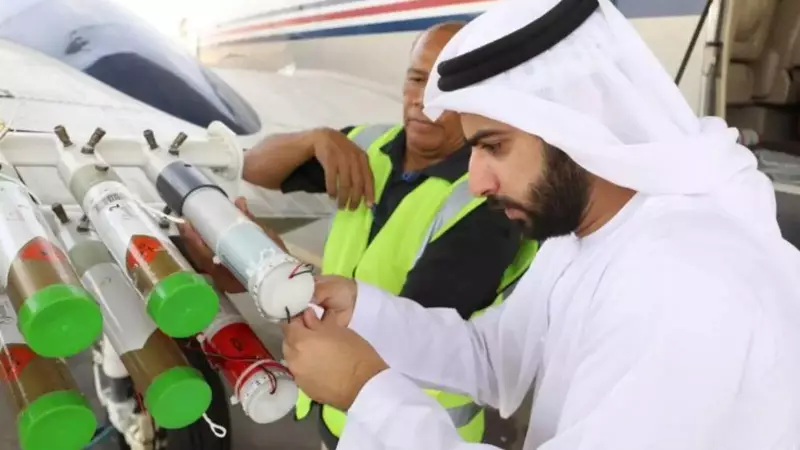
Forget the dramatic movie scenes of sudden desert downpours. In the United Arab Emirates, rainfall is often a carefully orchestrated scientific endeavour, not a mere chance of nature. In one of the planet's most arid zones, receiving under 100 mm of rain annually, scientists are actively coaxing the skies to release more water. This is the reality of the UAE's ambitious cloud-seeding programme, a sophisticated fusion of meteorology, aircraft, salt crystals, and cutting-edge artificial intelligence.
The Science of Coaxing Clouds: Planes, Salt, and Smart Tech
The core idea is enhancement, not creation. The programme does not conjure rain from empty skies but amplifies potential within existing clouds. Teams of scientists maintain a constant vigil, scanning the atmosphere with advanced weather radars and a network of 26 live cameras. Their target: promising cumulus clouds ripe with moisture.
When conditions align, the operation springs into action. Specially equipped aircraft take off, navigating into the rising air currents within these clouds. Here, they release seeding agents—tiny particles often composed of salts like sodium chloride, potassium chloride, and magnesium. These microscopic crystals act as nuclei, attracting water vapour and encouraging droplets to cluster and grow. As these droplets become heavier, they fall as rain instead of evaporating in the hot, dry desert air.

The scale is significant. In 2025 alone, the UAE conducted 172 cloud-seeding flights, a testament to the programme's operational intensity.
Next-Gen Rain Tech: Nano-Materials and AI Targeting
Far from being a relic of past science, the UAE's programme is at the forefront of innovation. Major investments are being made in several advanced areas:
- Nano-materials: Newly engineered seeding agents, potentially three times more effective than traditional flares, are being deployed.
- AI-Guided Targeting: Artificial intelligence algorithms sift through massive weather datasets in real-time, helping meteorologists pinpoint the optimal clouds and moments for seeding, maximising the success rate of each flight.
- Ground-Based Generators: In mountainous regions, stations on the ground release seeding materials into updrafts, offering an alternative to aerial missions.
This suite of technologies is transforming cloud seeding from a simple aerial technique into a precise 'rain-tech' industry.
Does It Work? Measuring the Impact on Water Security
Data and studies indicate that under the right conditions, cloud seeding can increase rainfall by roughly 10% to 25%. In a region where every drop is precious, this gain is substantial. Some research links seeded storms to hundreds of millions of cubic metres of additional water reaching the ground annually—a critical contribution to national water security.
However, experts are clear about its limits. Cloud seeding is not a magic wand; it cannot generate storms from clear skies. It requires pre-existing moist clouds, and its effectiveness varies with atmospheric conditions. The UAE faces acute water challenges, driven by rapid growth and limited natural freshwater, relying on a triad of desalination, water recycling, and cloud seeding.
Financially, cloud seeding presents a compelling case. With an operational cost of about US $8,000 per flight hour, it is far more economical than the massive energy and infrastructure required for desalination. This cost-benefit rationale underpins the UAE's multi-million dollar investment in local research, material manufacturing, and global scientific partnerships.
Despite its scientific basis, the programme sometimes faces public misunderstanding. It is occasionally wrongly blamed for extreme weather events like floods. Meteorologists emphasise that cloud seeding cannot create or control major storms; such events are natural phenomena. The technology's role is strictly to enhance rainfall within suitable cloud systems.

In essence, the UAE's cloud-seeding programme is a pragmatic, high-tech response to water scarcity. As climate change exacerbates weather unpredictability, such rain enhancement technologies are becoming an increasingly valuable tool. Blending aircraft, drones, nano-powders, and AI, it stands as a unique desert-born experiment in making the skies more cooperative—a real-world rain machine that the world's water-stressed regions are watching closely.