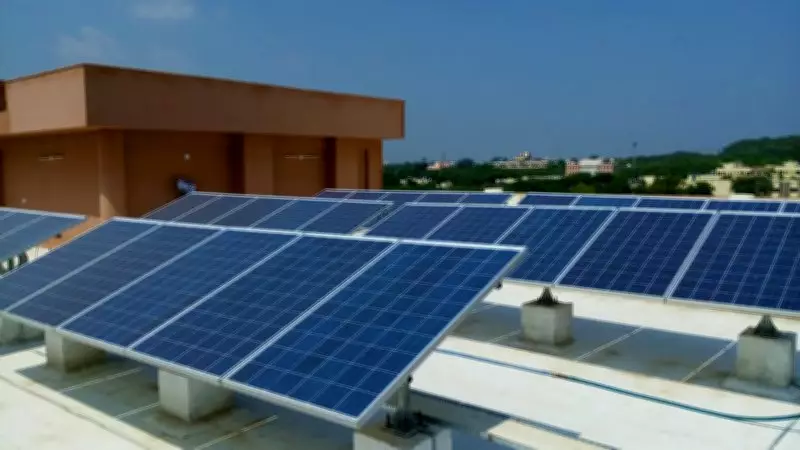
The Haryana government has announced a revised Solar Energy Promotion Scheme that provides interest-free financial assistance to domestic consumers for installing rooftop solar plants, in addition to the central subsidy. The initiative aims to install 2.22 lakh rooftop solar plants across the state by 2027, potentially benefiting lakhs of households.
Key Announcement by Energy Minister Anil Vij
Haryana Energy Minister Anil Vij stated that Chief Minister Nayab Singh Saini has approved amendments to the Standard Operating Procedure (SOP) of the scheme to make it more effective. The interest-free assistance reduces the initial investment burden, enabling substantial savings on electricity bills for consumers.
Target and Eligibility Criteria
The state targets installing 2.22 lakh rooftop solar plants by 2027. Eligible consumers can install plants of up to 5 kW capacity. Special benefits extend to non-defaulting consumers, state government employees, and Antyodaya families. For Category-1 non-defaulting consumers, the earlier requirement of paying bills on time for three consecutive years has been removed; now, being a non-defaulter in the immediately preceding billing cycle suffices.

Antyodaya families with an annual income up to Rs 3 lakh (as per Family ID/Parivar Pehchan Patra) are eligible for state financial assistance for plants up to 2 kW. State government employees, including HKRN staff with employment security, can avail benefits for plants up to 5 kW, provided they were not defaulters in the previous billing cycle.
Simplified and Digital Process
Vij emphasized that the entire process is transparent, simple, and digital. Consumers can check eligibility through the DISCOM portal and complete applications seamlessly via the National Portal. Applicants must ensure no other electricity connection in their name within any Haryana DISCOM has outstanding dues, ensuring benefits reach only genuine consumers.
Impact on Consumers
The scheme is expected to significantly boost rooftop solar adoption, reduce electricity costs, and contribute to the state's renewable energy goals. By easing eligibility conditions and providing interest-free loans, the government aims to make solar energy accessible to a broader population.