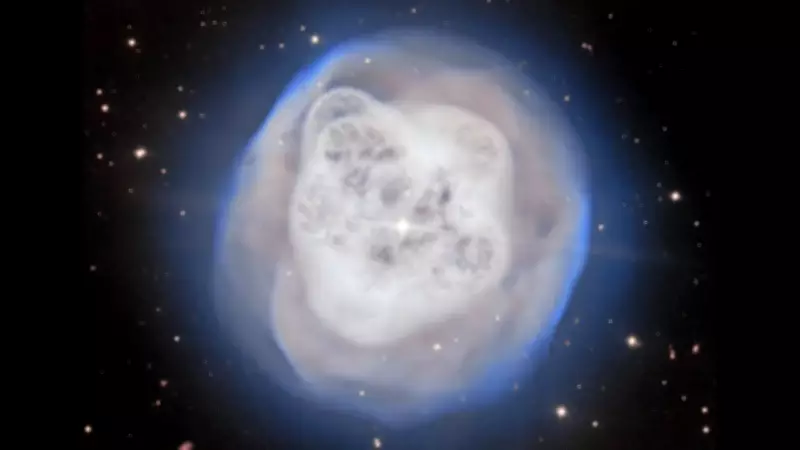
Astronomers have captured a striking new image of a dying star system that resembles a milky white crystal ball. The image, released by the US National Science Foundation's NOIRLab, was taken by the Gemini North Telescope located atop Mauna Kea in Hawaii. It shows a binary star system about 1,500 light-years from Earth surrounded by a luminous, spherical cloud of gas known informally as the Crystal Ball Nebula.
Formal Designation and Classification
Formally designated NGC 1514, the object is classified as a planetary nebula, a type of cosmic structure formed when a star nearing the end of its life expels its outer layers into space. The exposed stellar core emits intense ultraviolet radiation that heats the surrounding gas to temperatures of tens of thousands of degrees, causing it to glow brightly.
Stellar Evolution and Binary Interaction
Astronomers believe one of the two stars in the binary system, once larger than the Sun, has already entered this advanced stage of stellar evolution. Scientists also say the gravitational interaction between the two stars likely contributes to the nebula's remarkably symmetrical and almost spherical appearance.

This discovery provides valuable insights into the final stages of stellar life cycles and the role of binary systems in shaping the structures of planetary nebulae. The Crystal Ball Nebula's unique shape offers a rare opportunity to study the complex dynamics between dying stars and their companions.
The TOI Science Desk, an inquisitive team of journalists, continuously explores the realms of discovery to curate captivating news, features, and articles from the ever-evolving world of science. They aim to demystify scientific intricacies, making them accessible and engaging for all readers.