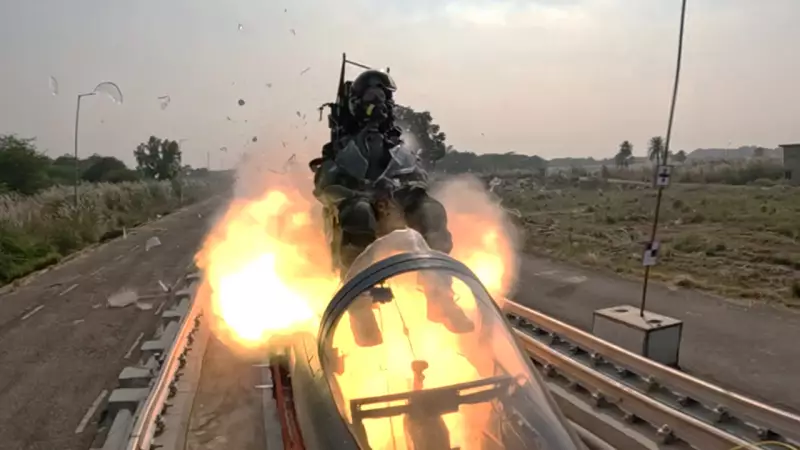
In a significant leap for India's indigenous defence capabilities, the Defence Research and Development Organisation (DRDO) has successfully executed a complex high-speed rocket-sled test for a fighter aircraft escape system. This landmark trial places the nation among a select group of countries with advanced in-house testing facilities for such critical safety technology.
Simulating Real-Life Emergency Scenarios
The dynamic test was conducted at the Rail Track Rocket Sled (RTRS) facility of the Terminal Ballistics Research Laboratory in Chandigarh. Unlike static tests, this trial was designed to closely mimic the extreme conditions of an actual in-flight emergency. The primary objectives were to validate the canopy severance mechanism and the precise sequencing of the ejection process, ensuring complete and safe aircrew recovery.
A collaborative effort involving the Aeronautical Development Agency (ADA) and Hindustan Aeronautics Limited (HAL), the test utilized a dual-sled system fitted with the forebody of an LCA (Light Combat Aircraft) Tejas. This assembly was propelled to a precisely controlled, high velocity through the phased firing of multiple solid-propellant rocket motors.

Meticulous Data Collection and Analysis
To capture every critical parameter, an instrumented Anthropomorphic Test Dummy was placed in the ejection seat. This dummy recorded vital data on loads, moments, and accelerations experienced during the high-speed ejection sequence. The entire event was documented by sophisticated onboard and ground-based imaging systems, providing a comprehensive visual record for analysis.
The successful demonstration was witnessed by certification officials from the Indian Air Force (IAF) and the Institute of Aerospace Medicine, underscoring its importance for future operational clearance of indigenous aircraft systems.
A Milestone for Atmanirbharta in Defence
Defence Minister Rajnath Singh extended his congratulations to the DRDO, IAF, ADA, HAL, and industry partners. He hailed the test as a significant milestone in India's journey towards self-reliance (Atmanirbharta) in defence technology. The capability to conduct such sophisticated dynamic ejection trials domestically reduces dependency on foreign test facilities and accelerates the development cycle for homegrown fighter aircraft.
Echoing the sentiment, Dr. Samir V Kamat, Secretary of the Department of Defence R&D and Chairman of DRDO, commended the entire team for the flawless execution of this complex test. This achievement not only enhances the safety paradigm for Indian pilots but also solidifies the country's standing in the global aerospace engineering community.