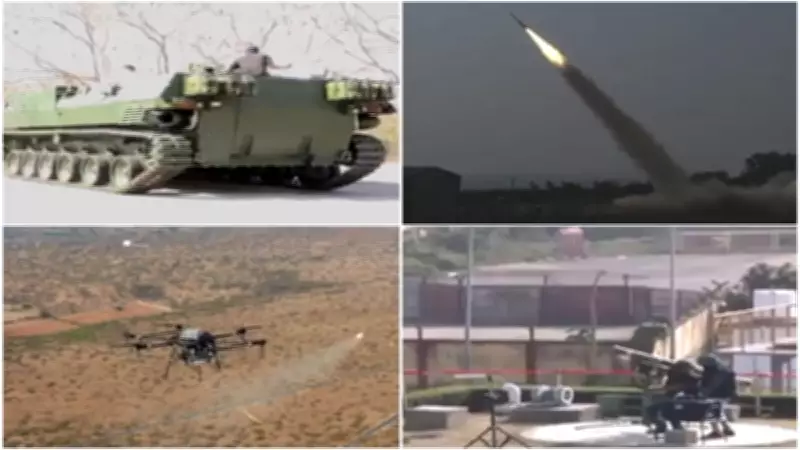
The Defence Research and Development Organisation (DRDO) has been at the forefront of India's quest for self-reliance in defence and space technologies. From developing advanced missile systems to contributing to the ambitious Gaganyaan mission, DRDO's contributions are pivotal in shaping India's strategic capabilities.
Missile Development: A Cornerstone of India's Defence
DRDO's missile programme has been a remarkable success story, with systems like Agni, Prithvi, and BrahMos showcasing India's prowess. The Agni series, including the Agni-V with a range of over 5,000 km, has strengthened India's nuclear deterrence. Similarly, the BrahMos supersonic cruise missile, developed in collaboration with Russia, is a key asset for the Indian Armed Forces. Recently, DRDO has been focusing on next-generation missiles with enhanced accuracy and manoeuvrability.
Armoured Warfare: Enhancing Battlefield Capabilities
In the realm of armoured warfare, DRDO has developed the Arjun main battle tank and the Nag anti-tank guided missile. The Arjun tank, with its advanced composite armour and fire control system, provides a significant edge in tank warfare. DRDO is also working on future combat vehicles, including the Future Ready Combat Vehicle (FRCV), to replace older platforms. Additionally, the development of the Nag missile, which can engage targets with top-attack capability, adds to India's anti-armour arsenal.

Contributions to Space: The Gaganyaan Mission
DRDO's expertise extends to space, particularly through its support for the Indian Space Research Organisation (ISRO) in the Gaganyaan mission. DRDO has developed critical technologies for crew safety, including life support systems, crew escape systems, and parachutes. The organisation's laboratories have also contributed to the development of space-grade materials and thermal protection systems. This collaboration underscores the synergy between defence and space sectors in India.
Self-Reliance in Air Defence
India's air defence capabilities have been bolstered by DRDO's indigenous systems like the Akash missile system and the Quick Reaction Surface-to-Air Missile (QRSAM). The Akash system, already in service with the Indian Army and Air Force, provides medium-range air defence. DRDO is also developing the long-range SAM (LR-SAM) and the medium-range SAM (MR-SAM) in partnership with Israel. These systems reduce dependence on foreign imports and enhance India's air defence network.
Future Prospects and Challenges
DRDO continues to innovate with projects like the hypersonic technology demonstrator and directed energy weapons. However, challenges remain in terms of timely delivery and integration of complex systems. The organisation is adopting new management practices and fostering private sector partnerships to accelerate development. The goal is to achieve complete self-reliance in critical defence technologies by 2047, aligning with India's vision of a developed nation.
In conclusion, DRDO's contributions from missiles to Gaganyaan are driving India's self-reliance in defence and space. With ongoing projects and collaborations, the organisation is poised to play a key role in India's strategic autonomy and technological advancement.