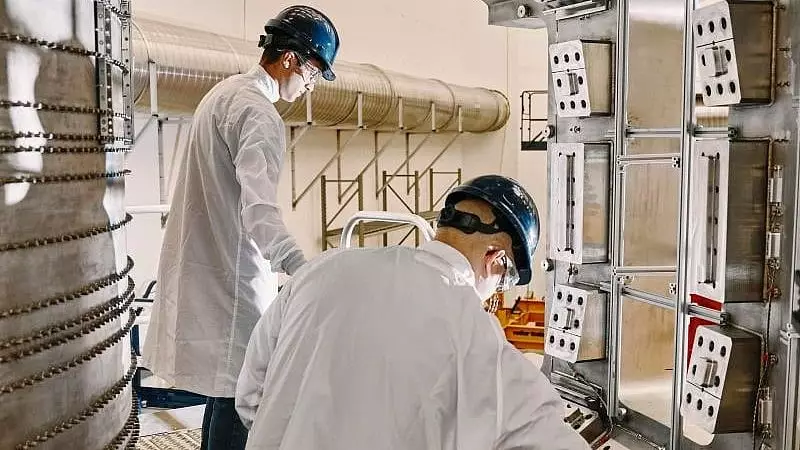
The global quest for a near-limitless source of clean power is accelerating, and China is placing a massive bet. The nation is aggressively advancing its nuclear fusion program, investing billions to master the technology that replicates the sun's energy process here on Earth.
China's Artificial Sun and the Massive Investment
Central to China's ambitions is the Experimental Advanced Superconducting Tokamak (EAST), often dubbed an 'artificial sun'. Located at the Hefei Institutes of Physical Science, this reactor has achieved significant milestones. In a landmark 2021 experiment, EAST maintained a plasma temperature of 120 million degrees Celsius for 101 seconds, and a staggering 160 million degrees Celsius for 20 seconds. These figures are critical as they demonstrate progress toward the sustained, ultra-hot conditions needed for fusion to occur.
This scientific push is backed by substantial financial commitment. Reports indicate China has allocated approximately $3.9 billion (around 28 billion yuan) for its fusion research program. A major portion of this funding is directed toward the China Fusion Engineering Test Reactor (CFETR), designed to be the next-step device that will bridge the gap between experimental reactors like EAST and a future commercial fusion power plant.

The Global Fusion Race and International Collaboration
While China is advancing rapidly, it is not alone in this high-stakes race. The pursuit of fusion energy is a truly global endeavor. The flagship international project is ITER (International Thermonuclear Experimental Reactor), currently under construction in Cadarache, France. ITER is a collaborative effort involving 35 countries, including China, the European Union, India, Japan, Russia, South Korea, and the United States.
The goal of ITER is to prove the scientific and technological feasibility of fusion energy on a large scale. It aims to produce ten times more energy than is used to heat the plasma. China is a key contributor to ITER, providing crucial components like superconducting magnets and facing what is essentially a learning platform for its domestic program, particularly the CFETR.
Private companies are also entering the fray. Start-ups like Commonwealth Fusion Systems in the US and Tokamak Energy in the UK are exploring alternative approaches, often with smaller, more modular reactor designs, adding another layer of competition and innovation to the field.
Why Fusion? The Promise of a Clean Energy Revolution
The intense global interest in fusion stems from its transformative potential. Unlike nuclear fission, which splits atoms and produces long-lived radioactive waste, fusion combines light atoms (like hydrogen) under extreme heat and pressure, releasing enormous energy. The primary fuel, deuterium, can be extracted from seawater, making it virtually limitless.
The process generates no carbon emissions during operation and poses no risk of catastrophic meltdowns. A successful commercial fusion reactor would provide a constant, reliable baseload power source, complementing intermittent renewables like solar and wind. This makes it a potential cornerstone for a future decarbonized global energy grid.
However, immense challenges remain. Containing and sustaining the super-hot plasma, managing extreme neutron bombardment on reactor materials, and ultimately achieving net energy gain in a cost-effective manner are monumental engineering and physics hurdles. The timeline for a working power plant is still measured in decades, with most experts suggesting the second half of this century.
The Road Ahead and Strategic Implications
China's systematic, well-funded approach positions it as a formidable contender in the fusion arena. The CFETR project is planned to begin operation around 2035, aiming to demonstrate full-cycle fusion energy generation and tritium breeding—a key step for fuel self-sufficiency.

Whoever achieves commercial fusion energy first will gain not just immense scientific prestige but also significant geopolitical and economic advantages. It could redefine energy security and provide a dominant position in the next global energy paradigm. The race for the sun on Earth is on, and China is determined to be at the forefront, investing heavily to turn this dream of limitless clean energy into a reality.