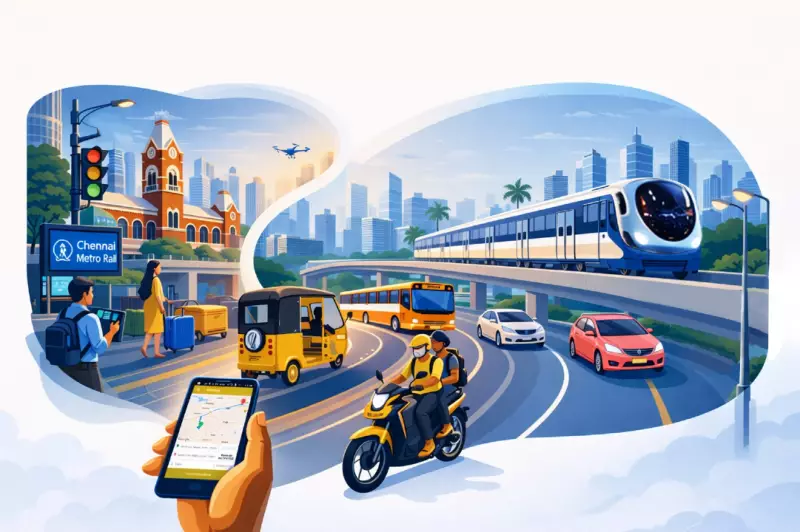
For Chennai, the future of urban mobility is no longer a distant concept confined to policy papers. As the city looks towards 2026, artificial intelligence, automation, and digitisation are actively transforming how its millions of residents move. The most significant leap in this direction is the planned introduction of driverless trains on the Chennai Metro's expansive Phase-II network.
The Driverless Metro: Automation with a Human Touch
Marking a major infrastructural upgrade, the Chennai Metro Rail Limited (CMRL) has awarded a massive ₹1,538-crore contract to Alstom. The deal involves supplying 32 driverless train sets with 96 coaches, which will operate on the 118.9 km network spanning three new corridors. These trains will be equipped with the advanced Unattended Train Operation (GOA-4) technology.
CMRL Managing Director, M A Siddique, clarifies that while the trains are driverless, human oversight remains paramount. "Driverless trains in upcoming projects are just engineering-based automation. Human supervision will remain central to operations," he stated. Functions like train movement, speed regulation, stopping accuracy, and door operations will be managed by Automatic Train Operation, with safety ensured via Automatic Train Protection systems. A central operations control centre will monitor all movements in real-time, with staff ready to intervene during emergencies or service disruptions.

Puneet Srivastava, Managing Director for Signalling and Infrastructure at Alstom India, highlights AI's crucial behind-the-scenes role in design, signalling, and maintenance. "In signalling, AI is used in all phases," he explained, from requirement capturing to software coding and testing. For predictive maintenance, AI algorithms will determine the optimal time for a train to undergo servicing, ensuring each rolling stock is used optimally.
AI Expands Across Chennai's Transport Ecosystem
The integration of intelligent systems is becoming increasingly visible across the city. The Greater Chennai Traffic Police has deployed adaptive traffic signals at key junctions. These systems use real-time data to dynamically adjust signal timings based on actual vehicle flow, helping manage congestion, especially during peak hours.
Meanwhile, the Metropolitan Transport Corporation (MTC) is using GPS-based fleet management to track buses, reduce bunching, and provide real-time arrival updates. Commuters can access this information through the Chennai One mobile app and display boards at select stops. I Jeyakumar, Member-Secretary of the Chennai Unified Metropolitan Transport Authority (Cumta), notes that the app, with over 8 lakh downloads since its launch, is integrating various commute modes, including fares and schedules. Digital integration has streamlined processes, like the shift from manually issuing 60,000 card passes annually to a fully digital system.
Algorithm-based studies are also guiding infrastructure planning. By analysing movement patterns from camera data, authorities have proposed projects like the Kilambakkam skywalk and revamps of Tambaram and Guindy stations with improved intermodal connectivity.
The Human Element and Intelligent Signals
Despite technological advances, 2025 demonstrated the limits of automation. During severe monsoon floods, algorithms could not reroute traffic. Personnel from traffic police, MTC, and metro services had to make manual adjustments based on ground conditions and crowd feedback. P Vijayakumar, Traffic Joint Commissioner (South), emphasised, "It won't eliminate manpower, but make their job easier."
Cumta is experimenting with 165 intelligent traffic signals that can detect emergency vehicles like ambulances and automatically give them a green light. These signals assess traffic volume and adjust timings autonomously. MTC, in collaboration with IIT Madras, plans to test intelligent systems on the Alandur–Airport route next year to potentially speed up bus movement.

For Chennai's commuters, the impact is already tangible: fewer sudden traffic snarls at certain junctions, more accurate bus arrival predictions, and smoother metro operations. As one traffic official put it, data now allows for a dynamic response to building congestion, moving beyond fixed-cycle signal systems. The city's journey towards a smarter, AI-augmented transport network is firmly on track, balancing cutting-edge technology with essential human judgment.