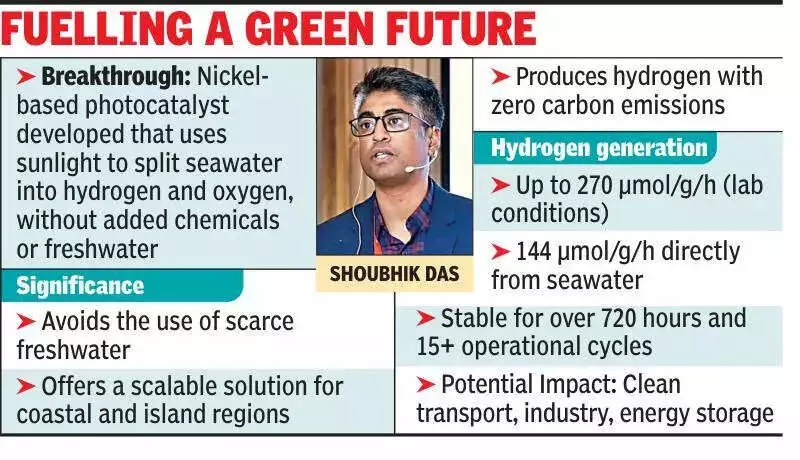
In a significant scientific leap with global implications, a Bengali scientist is spearheading revolutionary research to produce clean fuel directly from seawater using sunlight. This innovation promises to redefine green hydrogen production in a world increasingly stressed by freshwater scarcity.
The Visionary from Nadia and the Global Challenge
The groundbreaking work is led by Professor Shoubhik Das, an alumnus of Kolkata's prestigious Presidency College, who hails from Payradanga village in Nadia district, West Bengal. He and his team at the University of Bayreuth are tackling a critical flaw in current green hydrogen technology: its heavy reliance on precious freshwater. While hydrogen is hailed as the ultimate clean fuel—emitting only water when used—most sustainable production methods consume vast amounts of freshwater, a resource under severe strain globally.
A Nickel Catalyst That Changes the Game
The core of this breakthrough, detailed in the Journal of the American Chemical Society, is a novel photocatalyst based on nickel. The researchers engineered the material so that nickel atoms are dispersed individually at the atomic level. When this catalyst is exposed to sunlight, it efficiently splits water molecules into hydrogen and oxygen.

Professor Das explained the key advantage: their system requires no added chemicals or sacrificial reagents, a longstanding limitation that compromised the sustainability of earlier photocatalytic methods. "Our goal was to move closer to truly green hydrogen," Das stated. "We wanted a system that works efficiently, stably, and directly with real-world water sources."
Striking Results and a Durable Solution
The laboratory results are highly promising. The catalyst demonstrated impressive hydrogen production rates of up to 270 micromoles per gram per hour. Crucially, it performed exceptionally well using actual seawater, achieving a rate of 144 micromoles per gram per hour under natural sunlight.
Equally important is the catalyst's durability. It remained stable and highly active for over 720 hours of continuous operation, maintaining performance across multiple cycles. Advanced analysis confirmed the stability of its unique atomic structure, which is key to its efficiency and robustness.
Redefining the Future of Clean Fuel Production
The implications of this research are profound. By successfully using seawater—which covers over 70% of the planet—the technology sidesteps ethical and environmental conflicts over using freshwater for fuel. "If seawater can be used directly and safely for hydrogen production, it changes the entire equation," Professor Das emphasized.
This opens the door to a future of decentralized hydrogen generation along coastlines. Scientists can now envision coastal or even floating facilities where abundant sunlight and seawater combine to produce clean fuel without competing with community or agricultural water needs. For a water-stressed world, this Bengal-born innovation lights a path toward a more sustainable and equitable energy future.