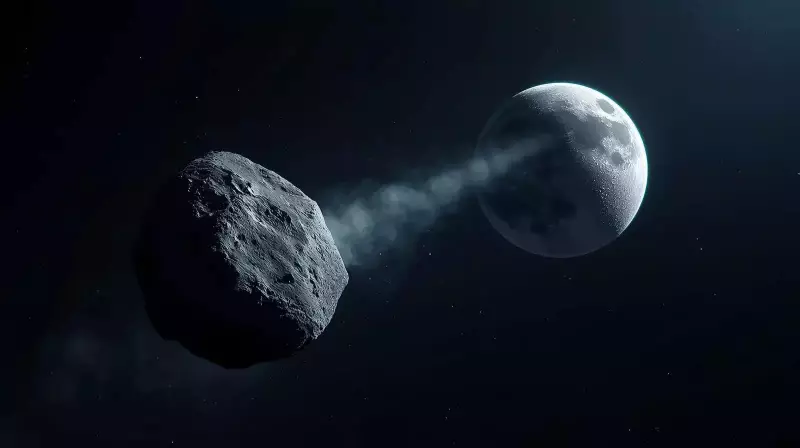
A newly discovered asteroid, named 2024 YR4, is on a potential collision course with the Moon, setting the stage for what could be the most significant lunar impact event in the last five millennia. Scientists are currently tracking this 60-metre-wide space rock, which has a calculated 4% probability—or 1 in 25 odds—of striking the lunar surface in December 2032.
The Potential Impact: A Spectacle and a Threat
If the asteroid hits, the event would be cataclysmic. The energy released would be equivalent to six million tonnes of TNT, which is roughly 400 times more powerful than the atomic bomb dropped on Hiroshima. Such an impact would carve out a fresh crater on the Moon approximately one kilometre wide.
For observers on Earth, the collision would not go unnoticed. Dr Andrew Rivkin, a planetary scientist from the Johns Hopkins Applied Physics Laboratory, explains that a brilliant flash would be visible. "I’d expect it’ll be a very bright point of light on the Moon for a few seconds, which then fades away," he said. The spectacle could be seen from a vast region stretching from eastern North America to Hong Kong, with Hawaii offering one of the best vantage points.

Uncertain Trajectory and the Race for Data
However, the current 4% impact chance is far from certain and is expected to change. The asteroid's path will become clearer in February, when it emerges from behind the Sun. This will provide the James Webb Space Telescope with a brief, critical window to capture images and refine trajectory data. The next major observation opportunity isn't until 2028, which some experts worry might be cutting it too close to mount a defence mission if the threat level increases.
The scientific community is divided on the implications. One major concern is that a lunar impact could send a shower of debris hurtling towards crucial satellites in Earth's orbit. Conversely, others see 2024 YR4 as a unique opportunity to test planetary defence systems for the Moon, especially as plans for habitable lunar outposts in the mid-2030s progress. Since the Moon lacks a protective atmosphere, having a tested defence strategy is considered prudent.
Planning a Defence: To Nuke, Nudge, or Wait?
Discussions on how to potentially deflect 2024 YR4 are already underway. A paper published in September 2024 suggested a nuclear option, proposing that spacecraft could launch between late 2029 and 2031 to intercept and "nuke" the asteroid. The authors argued that other deflection methods, like using gravity tractors or ion beams from a hovering spacecraft, seem impractical given that YR4's true mass is still unknown and such techniques require years to take effect.
The only planetary defence method proven in a real test is the kinetic impactor. NASA successfully used this technique in 2022, smashing the DART spacecraft into the moonlet Dimorphos. Rahil Makadia, a planetary defence researcher from the University of Illinois, notes that because 2024 YR4 is relatively small, a similar kinetic impactor could be used to "robustly disrupt it."
Despite the advanced planning, the prevailing sentiment among experts is caution. Dr Rivkin emphasises that there is still a 96% chance the asteroid will miss the Moon. "In a few months, we will make more observations and have a better understanding... but even then, it’s not obvious that we would choose to deflect it," he stated. Any decision would involve a global consortium weighing all consequences.
Echoing this wait-and-see approach, Richard Moissl, head of the European Space Agency's Planetary Defence Office, confirmed to 'New Scientist' that they have decided to wait until next year for more data before considering any action. The world will be watching closely as February's observations bring the future of 2024 YR4 into sharper focus.