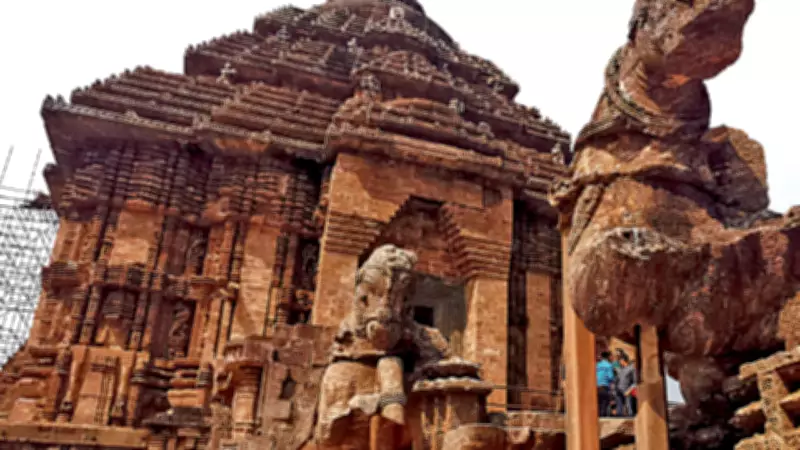
The Archaeological Survey of India (ASI) has initiated a landmark conservation exercise at the Sun Temple in Konark, Odisha's only UNESCO World Heritage Site. For over a century, a massive sand filling concealed part of the 13th-century architectural marvel's grandeur. Now, ASI is carefully removing this sand, opening a new chapter in the preservation of the monument.
Historical Background
ASI records indicate that the temple began to deteriorate structurally from the 17th century onwards, with the main Sikhara collapsing in stages until 1848. By the early 19th century, the plinth on which both the main temple and the Jagamohan (assembly hall) stand had been buried under sand dunes. Conservation efforts spanned nearly two centuries, but significant structural work only began in 1901 under Governor Sir John Woodburn. Initial excavations revealed intricate carvings, yet the Jagamohan's restoration remained difficult due to extensive damage on the southern side and around the northern and eastern doorways.
The Sand Filling Decision
Historians note that an initial proposal suggested filling the interior up to a height of 40 feet with stones and constructing a central pillar to support the roof. This idea was later abandoned. Instead, British engineers decided to fill the interior with sand and seal the doorways. The inner walls were lined with 15-foot-thick dry-stone masonry to counterbalance horizontal thrust. This unusual protective measure kept the interior hidden for over a century.

Modern Conservation Efforts
Over the years, archaeologists from India and abroad repeatedly demanded the removal of the sand to assess the structural health of the monument. The Central Building Research Institute's endoscopy investigation of the Jagamohan revealed fallen stones from the top resting on the sand filling at a depth of approximately 12.5 metres. The proposal for sand removal received approval from the then Union Culture Minister Prahlad Singh Patel in 2020.
Six years after the announcement, ASI has now initiated the evacuation process through the western side of the centrally-protected monument. Former ASI superintending archaeologist D B Garnayak, who initiated the current phase of work, said, "The process began after approval from ASI director general Yadubir Singh Rawat."
Technical Approach
IIT-Madras, collaborating with ASI to assess structural stability, examined the quality of stones and sand removed during two core drillings on the western wall in December 2023. The materials were found suitable for structural intervention. Over the last few years, ASI erected a 65- to 70-foot-high working platform from the 4.2-metre-high sculpted pedestal on which the Jagamohan stands. Using this platform, a 6-foot by 5-foot passage into the Jagamohan was drilled through the western wall using diamond drilling under RPM-controlled conditions. The opening was created near the Sukhanasi vent, located between the first and second pidhas, which had earlier been used by the British to pour sand into the structure. The wall will be cut through to a depth of 10 metres to reach the sand surface.
Phased Sand Removal
To remove sand untouched for 123 years, a 9-metre horseshoe-shaped iron tunnel featuring trolley tracks and gantries will be installed. Mechanized trolleys will then extract the sand, stone blocks, and debris in a phased operation. Officials stated that the mechanized tunnel enables controlled sand removal, minimizing manual risk to structural integrity. The process integrates evacuation with simultaneous conservation rather than treating it as a subsequent task. This phased approach gradually exposes the inner structure, allowing teams to document and repair stones in stages as sand levels decrease.
This exercise is regarded as a defining moment in Indian archaeology, promising to reveal hidden aspects of the Sun Temple's grandeur while ensuring its preservation for future generations.