NASA's Artemis II Mission Launches Historic Crew on Pioneering Lunar Journey
In a monumental leap for space exploration, four astronauts successfully launched aboard NASA's Artemis II mission on Thursday from the Kennedy Space Centre in Florida. This event marks humanity's first journey to the Moon's vicinity since the Apollo 17 mission in 1972, representing a crucial step toward returning humans to the lunar surface.
Historic Launch and Diverse Crew
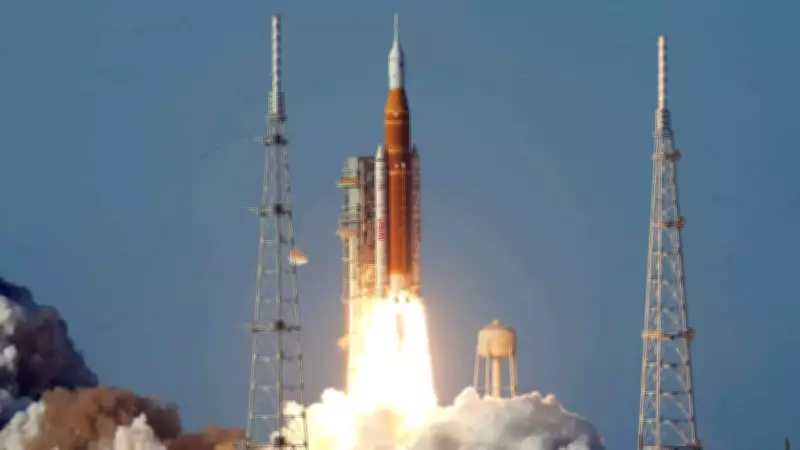
NASA shared captivating moments of the lift-off as the powerful Space Launch System rocket rose steadily into the dark sky. A thick plume of smoke and fire trailed the vehicle as it grew smaller on the horizon, symbolizing a new era in space travel.
Artemis II set sail from Florida's Kennedy Space Centre, utilizing the same launch pad that sent Apollo astronauts to the Moon decades ago. Surviving Moon walkers were present to cheer as the SLS rocket thundered into the evening sky.

Commander Reid Wiseman enthusiastically shouted, "Let's go to the moon!" leading a diverse crew that includes pilot Victor Glover, mission specialist Christina Koch, and Canadian astronaut Jeremy Hansen. This team represents NASA's most diverse lunar crew ever, featuring the first woman, the first person of color, and the first non-US citizen to journey to the Moon's vicinity in the Orion capsule, traveling approximately 248,000 miles away.
Crew Composition and Mission Details
The Artemis II crew consists of Commander Reid Wiseman, Pilot Victor Glover, and Mission Specialist Christina Koch from NASA, along with Mission Specialist Jeremy Hansen from the Canadian Space Agency. They will undertake a nearly 10-day mission that will take them several thousand miles beyond the Moon before returning to Earth.
The spacecraft will follow a free-return trajectory, leveraging the Moon's gravity to loop back without requiring additional engine burns. This path ensures a safe and efficient journey, testing critical systems for future missions.
Significant Firsts and Training
This mission includes several historic milestones. Victor Glover will become the first person of color to travel beyond low Earth orbit, Christina Koch will be the first woman to journey to the Moon's vicinity, and Jeremy Hansen will be the first non-American to reach this distance.
After almost three years of intensive training, this team is the first to fly in NASA's Artemis program, which was initiated in 2017. The program aims to establish a long-term human presence on the Moon over the next decade, paving the way for sustainable exploration.
Importance of the Artemis II Mission
Artemis II serves as the first crewed flight of NASA's Space Launch System rocket and Orion spacecraft, designed to carry humans deeper into space than any system since the Apollo era. The mission will rigorously test life-support systems, navigation capabilities, and deep-space communication technologies that are critical for future lunar landings.
The farthest point of the journey will take the crew about 4,700 miles beyond the Moon, farther than any human has traveled since the last Apollo mission. Reentry is expected to be the most challenging phase, with the Orion capsule returning to Earth's atmosphere at approximately 25,000 miles per hour. A revised trajectory has been implemented to ensure the heat shield performs safely under extreme conditions.
Background on the Artemis Program
The launch represents a significant milestone for NASA's Space Launch System rocket, which has undergone more than ten years of development. Approximately three and a half hours after launch, the Orion capsule, built by Lockheed Martin, will separate from the rocket while in Earth's orbit. The crew will then take manual control to test the spacecraft's maneuverability and steering, completing the first of many planned evaluations.
Artemis II is an early and vital mission in NASA's broader Moon program, with the goal of landing astronauts on the lunar surface again by 2028 through the Artemis IV mission. NASA faces pressure to achieve this objective, as China is also expanding its Moon program and plans to send astronauts there as early as 2030, highlighting the competitive nature of global space exploration.