Innovation often takes the most unexpected paths. Many of the everyday items that fill our homes and simplify our lives were not born from a direct intention to solve the problem they ultimately address. Instead, they emerged from failed experiments, serendipitous accidents, or were products in search of a purpose. This journey from obscure origin to indispensable utility is a powerful reminder that creativity and adaptation are at the heart of human progress. Let's explore the fascinating backstories of seven such commonplace inventions that found their true calling far from their original blueprints.
The Kitchen Marvel Born from Radar
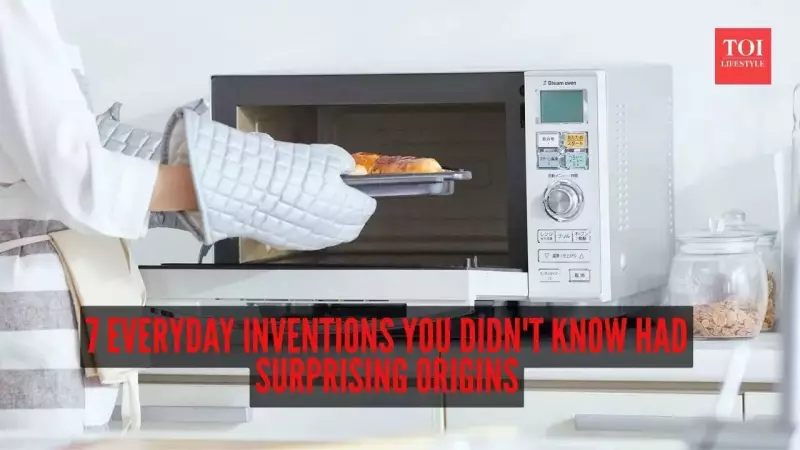
The ubiquitous microwave oven, a staple for quick heating and cooking, has a origin story rooted in military technology. In 1945, engineer Percy Spencer was working on radar equipment for the military when he made a curious discovery. He noticed that the electromagnetic waves from a radar device had melted a chocolate bar in his pocket. Intrigued, Spencer began experimenting with these waves on other foods, like popcorn kernels and eggs. This direct observation led to the development of the first microwave oven, transforming a tool of war into a revolutionary kitchen appliance.
From Failed Glue to Office Essential
The humble Post-it note is a classic tale of a "failure" finding its perfect application. In 1968, 3M chemist Spencer Silver was attempting to create a super-strong adhesive. Instead, he accidentally formulated a weak, pressure-sensitive glue that could stick to surfaces but was also easily repositionable. For years, this adhesive had no clear use. The breakthrough came when Silver's colleague, Arthur Fry, frustrated by bookmarks falling out of his hymnbook, applied the glue to paper strips. This simple act of problem-solving gave birth to the global phenomenon of sticky notes, turning a laboratory mishap into an organizational icon.

Wallpaper Dream Becomes Shipping Saviour
Today, the satisfying pop of bubble wrap is synonymous with packaging and protection. However, its inventors, Alfred Fielding and Marc Chavannes, had a very different vision in 1957. They sealed two shower curtains together, trapping air bubbles inside, aiming to create a revolutionary textured wallpaper. When this idea failed to captivate the interior design market, the product seemed destined for obscurity. Its potential was realized later when someone saw its excellent protective and cushioning properties, repurposing it as an ideal material for safeguarding fragile items during transit.
Another childhood staple, Play-Doh, began its life not as a toy but as a cleaning product. In the 1930s, it was formulated as a compound to clean coal residue from wallpaper in homes heated by coal furnaces. As modern heating systems replaced coal, the product's original purpose vanished. Its reinvention came when its non-toxic, malleable properties were recognized as perfect for children's creative play, transforming a niche cleaner into a beloved modeling compound.
The world's most famous soft drink, Coca-Cola, was conceived in 1886 by pharmacist John Pemberton as a medicinal syrup. It was marketed as a tonic to relieve headaches, fatigue, and other ailments. Its evolution from a patent medicine sold in drugstores to a global beverage giant is a story of marketing and a public embrace of its unique, refreshing taste, far removed from its therapeutic origins.
Even simple Scotch tape has an industrial beginning. It was invented by a 3M engineer who saw auto painters struggling with masking cars for two-tone paint jobs. The tape was specifically designed to adhere well enough to mask areas but remove cleanly without damaging fresh paint. Its clear, versatile cousin later found a permanent home in households worldwide for mending, sealing, and crafting.

The hook-and-loop fastener known as Velcro was inspired by nature. Swiss engineer George de Mestral invented it in 1941 after studying how burrs clung stubbornly to his clothes and his dog's fur during a walk. Mimicking this biological design, he created a general-purpose fastening system. While not intended for any specific item initially, its practicality led to widespread adoption in footwear, clothing, aerospace, and countless other fields.
Innovation Lies in the Pivot
These seven stories collectively highlight a crucial lesson in innovation: the original intention is just the starting point. True value is often uncovered through curiosity, observation, and the willingness to adapt. Failed concepts, side projects, and accidental discoveries can become irreplaceable pillars of daily life when viewed through a lens of possibility. They remind us that progress isn't always a straight line from problem to solution, but sometimes a winding path where the destination is more wonderful than the initial map could ever show.