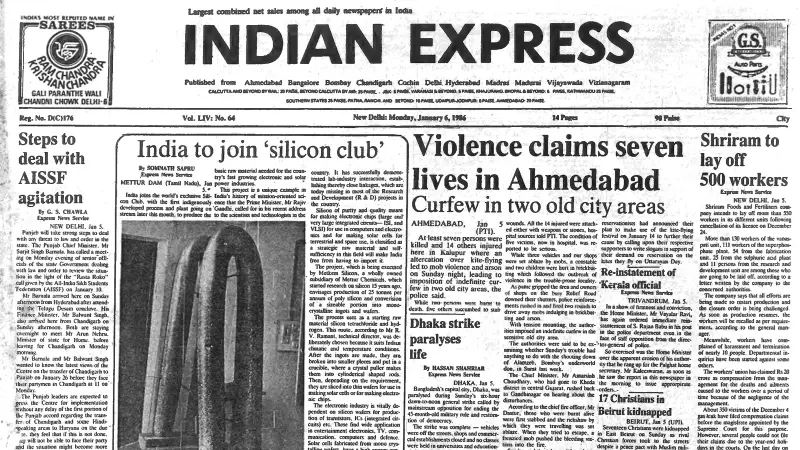
A historic front page from The Indian Express dated January 6, 1986, captured a nation at a technological crossroads while grappling with political instability and industrial turmoil. The day's headlines heralded India's entry into an exclusive global league, even as internal challenges threatened to unravel hard-won accords and livelihoods.
A Technological Milestone: India Joins the Silicon Club
The most prominent news was a landmark achievement for Indian science and industry. The nation was set to join the world's exclusive Silicon Club later in January 1986. This membership was granted by the imminent launch of the first indigenously developed process and plant to produce silicon, the basic raw material crucial for the fast-growing electronics and solar power industries.
This project was hailed as a unique example of mission-oriented science in India's history, a concept recently championed by Prime Minister Rajiv Gandhi in a public address. The development promised to reduce foreign dependency and fuel a new era of technological self-reliance.

Political Turbulence in Punjab
While the nation celebrated a technological feat, the state of Punjab was on edge. The Punjab Chief Minister, Surjit Singh Barnala, had vowed to take strong steps against any threat to law and order. This warning came in light of a "Rasta Roko" (road blockade) call given by the All-India Sikh Students Federation (AISSF) for January 10.
Chief Minister Barnala, who had just returned to New Delhi from a Telugu Desam conclave in Hyderabad, called an urgent meeting of senior state officials to review the situation. His Finance Minister, Balwant Singh, also arrived in the capital from Chandigarh, underscoring the gravity of the matter.
The report indicated a distressing start to the new year for Punjab and Haryana, with the July Rajiv-Longowal accord in imminent danger of collapsing. The analysis warned that if the accord failed, the Akali ministry—which had come to power less than four months prior—could fall, potentially giving a significant boost to Sikh extremists in the state.
Industrial Crisis: Mass Layoffs at Shriram Foods
In a separate blow to the industrial sector, Shriram Foods and Fertilisers announced its intention to lay off more than 550 workers across its various units. This drastic decision followed the cancellation of the company's licence on December 24, 1985.
The breakdown of the layoffs was detailed in a company letter to authorities:
- More than 130 workers from the vanaspati unit.
- 111 workers from the superphosphate plant.
- 54 workers from the fabrication unit.
- 25 workers from the sulphuric acid plant.
- 11 persons from the research and development unit.
This mass termination highlighted the fragile nature of industrial employment and the direct impact of regulatory decisions on hundreds of families, casting a shadow over the day's technological triumph.
Thus, January 6, 1986, remains etched in history as a day of stark contrasts—where a giant leap in national technological capability was juxtaposed against serious regional political instability and significant economic distress for workers.