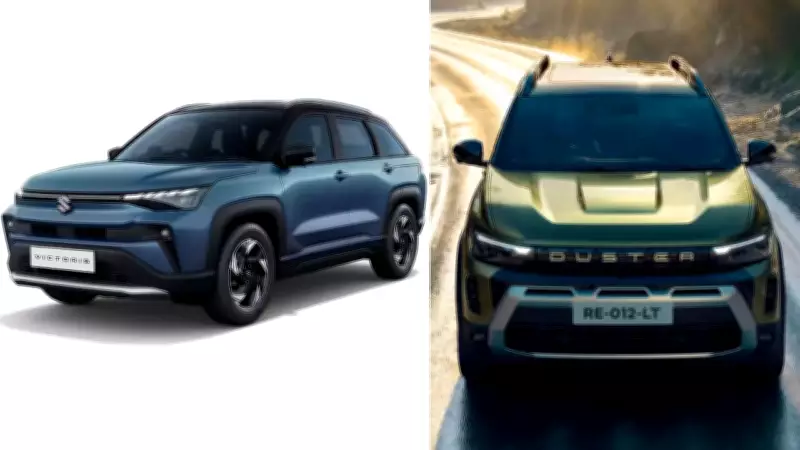
Hybrid SUV Showdown: Maruti Victoris vs Renault Duster Powertrain Analysis
The midsize SUV segment in India is fiercely competitive, with manufacturers constantly innovating to capture consumer interest. A significant trend emerging in this space is the adoption of strong hybrid technology, which combines petrol engines with electric motors for improved efficiency and performance. Two key players driving this shift are the Maruti Suzuki Victoris, launched last year, and the highly anticipated Renault Duster, which is set to enter the market with its own hybrid offering.
Maruti Suzuki Victoris: Compact and Efficient Hybrid System
The Maruti Suzuki Victoris employs a sophisticated strong-hybrid layout centered around a 1.5-litre petrol engine. This engine is seamlessly integrated with an electric motor and an e-CVT gearbox, creating a smooth and responsive driving experience. The combined power output of this system is approximately 116 horsepower and 141 Newton-meters of torque, providing adequate performance for urban and highway driving.
Supporting this setup is a compact 0.76 kWh battery pack, which aids in energy regeneration and electric-only driving in certain conditions. The Victoris offers drivers multiple drive modes, including Eco for maximum fuel efficiency, Normal for balanced performance, and Power for enhanced acceleration. The lightweight and compact nature of its hybrid system contributes to superior fuel economy, making it an attractive option for cost-conscious buyers.

Renault Duster: Powerful and Advanced Hybrid Architecture
Renault has taken a distinct approach with the Duster's hybrid technology, opting for a more robust system. It features a larger 1.8-litre four-cylinder petrol engine, paired with not one but two electric motors and a substantial 1.4 kWh battery pack. Power is transmitted to the wheels through a multi-mode automatic transmission, ensuring versatility across different driving scenarios.
This advanced configuration is expected to deliver a combined output of around 158 to 160 horsepower and approximately 172 Newton-meters of torque, positioning the Duster as a more powerful contender in the segment. A standout claim from Renault is that the Duster can operate in electric-only mode for up to 80 percent of city driving, significantly reducing emissions and fuel consumption in urban environments.
Key Differences and Market Implications
The disparity in output figures between the Victoris and Duster primarily stems from differences in engine size and battery capacity. The Duster's larger 1.8-litre engine and bigger 1.4 kWh battery enable it to produce stronger performance metrics, appealing to drivers seeking more dynamic capabilities. In contrast, the Victoris leverages its more compact and lighter hybrid system to excel in fuel efficiency, catering to those prioritizing economy and lower running costs.
This comparison highlights the evolving landscape of hybrid technology in India's automotive sector. As consumer awareness of environmental benefits and long-term savings grows, strong hybrid systems are becoming a critical differentiator in the competitive midsize SUV market. Both models represent significant steps toward mainstream adoption of hybrid vehicles, offering diverse options to suit varying driver preferences and needs.
The introduction of these hybrid powertrains not only enhances performance and efficiency but also aligns with broader trends toward sustainable mobility. As more manufacturers explore hybrid and electric solutions, the Indian automotive industry is poised for a transformative shift, with the Victoris and Duster leading the charge in their respective niches.