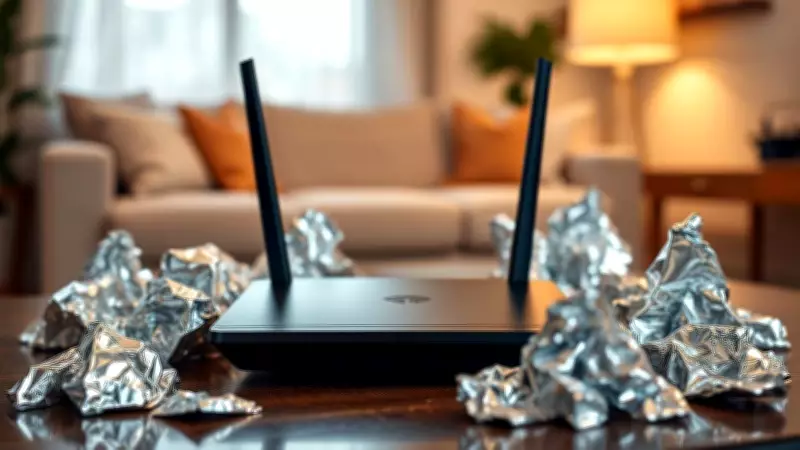
Boost Your Wi-Fi with a Simple Kitchen Hack: The Aluminium Foil Trick
We have all experienced it at some point: you are in the middle of a crucial video meeting or about to reach the climax of a streamed movie, and suddenly, the dreaded loading symbol appears. Frustration sets in, and thoughts turn to expensive solutions like upgrading your internet service provider or investing in a costly mesh network. However, an emerging trend among DIY enthusiasts and scientists suggests that the answer to eliminating those annoying dead zones might be hiding in your kitchen, right between the plastic wrap and parchment paper.
The Science Behind the Aluminium Foil Wi-Fi Hack
The logic behind this kitchen trick is straightforward and rooted in the principles of wireless signal propagation. Most routers use omnidirectional antennas that broadcast signals in all directions, creating a 360-degree coverage area. While this seems ideal, it often leads to wasted energy as signals bounce off outer walls, travel down unused corridors, or even leak outside your home. By placing a reflective metal sheet, such as aluminium foil, behind your router, you can capture and redirect these stray signals back into the room where you need them most.
This method might sound like a quirky tip from online forums, but scientific evidence lends it credibility. A study conducted at Dartmouth College, titled A Virtual Wall Improves Wireless Security and Performance, demonstrates that reflections from specific surfaces can significantly enhance indoor wireless signals. According to the research, specially shaped metal reflectors covered in aluminium foil can boost signal strength by up to six decibels. This improvement not only enhances performance but also adds a layer of security by preventing signals from reaching unwanted areas, effectively creating a virtual wall that keeps your data safe from external access.

How to Build Your Own Wi-Fi Signal Reflector
You do not need to be an engineer to construct this simple device at home. Follow these easy steps to create your own signal reflector:
- Cut a piece of cardboard into a curved shape, resembling a capital letter C. The curvature is crucial because a flat surface would merely reflect the signal without direction, while a curved surface can focus it toward a specific area.
- Cover the curved cardboard completely with aluminium foil, ensuring a smooth, mirror-like surface.
- Place the reflector behind your router's antennas, with the open end of the curve pointing directly toward your dead zone, such as a home office or distant bedroom.
Placement is key to maximizing effectiveness. As noted by experts like Asianet Broadband, this hack works by diverting signals rather than amplifying them, which might result in a slight reduction in signal strength behind the foil. However, for homes with unconventional room layouts or thick walls, this minor trade-off is often justified by the improved reliability in targeted areas.
Fine-Tuning Your DIY Installation
After setting up your aluminium foil reflector, some minor adjustments may be necessary to achieve optimal performance. Consider the following tips:
- Adjust the angle of the bend or elevate the reflector to avoid interference from large furniture or other obstacles that can block radio waves.
- Think of your Wi-Fi signal as a beam of light and the foil as a mirror; small tweaks can make a big difference in directing the signal precisely where needed.
- Experiment with different placements and shapes to find what works best for your specific environment.
This simple and cost-free experiment offers an opportunity to transform a weak connection into a highly optimized one, proving that sometimes the best solutions can be found right in your pantry. Whether you are dealing with spotty coverage or seeking to enhance security, the aluminium foil trick provides a practical and scientifically backed method to improve your home networking experience.