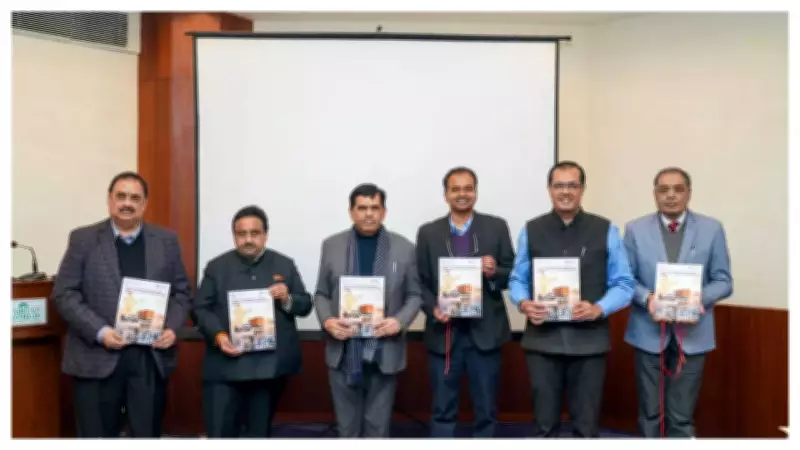
The Centre for Digital Economy Policy Research (C-DEP), in collaboration with the prestigious Indian Institute of Technology Delhi, unveiled a significant report on Tuesday at the India Habitat Centre in New Delhi. The study, titled ‘Study of Technology-Enabled Intra-City Logistics for MSMEs’, provides a comprehensive analysis of how modern, app-based goods transportation services are transforming the operational landscape for India's micro, small and medium enterprises.
Critical Support for India's Economic Backbone
MSMEs form the bedrock of the Indian economy, contributing approximately 30% to the nation's GDP and a substantial 45% of its industrial output. Despite this pivotal role, these enterprises have long grappled with persistent inefficiencies in moving goods within cities. Challenges such as exorbitant transport costs, unpredictable vehicle availability, and chronic delivery delays have hampered their growth and competitiveness.
The report, which synthesizes insights from direct interviews with MSME owners, detailed discussions with technology-enabled logistics service providers, and an extensive analysis of aggregated operational data, concludes that these digital platforms now play an indispensable role in supporting the day-to-day functions of small businesses across the country.

Key Findings: Dramatic Improvements in Efficiency and Reach
The study's data reveals compelling evidence of the transformative impact of tech logistics:
- Business users constitute about 71% of the user base on these platforms, yet they generate a staggering 97% of all intra-city goods transportation orders across two-wheeler, three-wheeler, and four-wheeler vehicle categories.
- Among the MSMEs surveyed, an impressive 73% reported a measurable reduction in their overall transportation costs.
- A remarkable 95% experienced significant improvements in the on-time transportation of their goods, enhancing reliability.
- Nearly 27% were able to expand their customer reach due to the newfound access to on-demand, flexible logistics solutions.
Faster vehicle availability and the ability to book right-sized vehicles enable MSMEs to complete more orders daily, drastically reduce coordination time, and manage priority shipments efficiently without the capital expenditure of maintaining owned fleets.
Policy Warnings: The Looming Threat of GST 2.0
The report sounds a strong cautionary note regarding emerging policy risks that could jeopardize these hard-won efficiency gains. A primary concern is the potential misclassification of digitally booked goods transport services under the proposed GST 2.0 framework. If these services are categorized as ‘Local Delivery Services,’ the applicable tax rate could skyrocket from the current 5% to a burdensome 18%.
Such a tax hike could increase per-trip logistics costs for MSMEs by over 12%, a devastating blow for small businesses operating on razor-thin margins. The study warns that higher costs may force these enterprises back toward informal, cash-based transport options, thereby reversing critical progress made in formalization, transparency, and service reliability within the sector.
Expert Insights from the Report Launch
The report was formally released by Praveen Khandelwal, Member of Parliament and Secretary General of the Confederation of All India Traders (CAIT), alongside Ashwini Mahajan, Co-Convener of the Swadeshi Jagran Manch.
Praveen Khandelwal emphasized, "The key to India becoming a developed nation depends on lowering logistics costs for our MSMEs. A significant part of logistics costs in India can be attributed to road transport. If India is to bring logistics costs down to 4-5% of GDP, improving cost efficiency in road-based and intra-city logistics will be key."

Dr. Jaijit Bhattacharya, President of C-DEP, provided a detailed analysis: "A significant share of logistics costs within road transport arises from intra-city goods movement. Technology-enabled goods transportation services are delivering tangible benefits for MSMEs by reducing intra-city logistics costs. Beyond cost savings, these services improve operational reliability and time efficiency, creating scope for higher MSME earnings and measurable gains in labour productivity. If higher taxes make these services unaffordable, MSMEs lose a tool that improves efficiency and customer trust. Better clarity would ensure that technology adoption is not penalised."
Ashwini Mahajan highlighted the innovative spirit of MSMEs: "MSMEs have always been the backbone of our economy, and today with intervention of technology, they have proven their mettle - from developing anti-drone systems to strengthening our defence sector, things we couldn’t imagine years ago. India's tech ecosystem, exemplified by UPI and our space capabilities, has grown so strong that other nations now seek to collaborate with us."
Professor P. Vigneswara Ilavarasan from IIT Delhi's Department of Management Studies noted: "MSMEs are greatly benefited by the tech-enabled goods transportation services by increasing their market reach, enhancing operational efficiency and helping achieve significant cost savings thereby contributing to sustainable growth. The extant regulatory environment should be an enabler to amplify the benefits."
Broader Ecosystem and Transition Challenges
The report also delves into the wider ecosystem dynamics. It identifies significant barriers faced by small, independent transporters in transitioning toward formalization, including complex compliance processes, cumbersome documentation requirements, and limited access to essential digital infrastructure.
Concurrently, the study acknowledges state government initiatives to promote fleet electrification, particularly in higher-payload freight segments, as a vital step toward sustainable mobility. It stresses that as this green transition progresses, continued alignment with electric vehicle availability and the expansion of charging infrastructure will be crucial to ensuring logistics services remain affordable for MSMEs during this shift.
Recommendations for a Sustainable Future
To address the identified challenges and safeguard the efficiency gains, the report puts forward several key recommendations:
- Provide clear regulatory clarification under the GST framework to prevent the misclassification and subsequent tax burden increase on tech-enabled logistics services.
- Promote the gradual formalization of informal transport operators through the strategic use of India's digital public infrastructure.
- Offer targeted Production-Linked Incentive (PLI) based support to facilitate an orderly and cost-effective transition to electric freight vehicles, ensuring logistics costs do not rise for MSMEs during this critical phase.
The comprehensive study underscores that while technology has unlocked unprecedented efficiency for India's MSMEs, supportive and clear-sighted policy will be the decisive factor in sustaining and amplifying these benefits for the nation's economic growth.