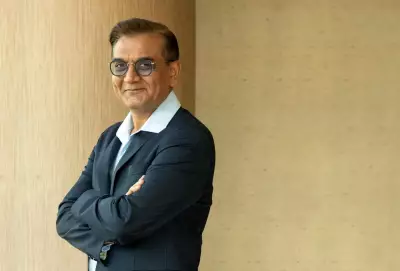
New Delhi witnessed a significant announcement this week regarding India's growing role in global technology leadership. Ministry of Electronics and Information Technology Secretary S Krishnan confirmed that India has received an invitation to join the Pax Silica initiative. This US-led strategic effort focuses on securing critical supply chains across silicon, advanced manufacturing, and artificial intelligence sectors.
Global Recognition of India's Strategic Position
Secretary Krishnan emphasized that this invitation represents clear global recognition. Countries worldwide now view India as a trusted partner in critical technology supply chains. He made these remarks during an event organized by Nasscom, India's premier technology industry body.
"Fundamentally, this is about addressing supply chains for critical minerals," Krishnan stated. "For a country like India, participation is crucial. This invitation truly recognizes the trust the world places in our capabilities."

Minister Vaishnaw's Washington Engagement
Krishnan revealed that IT Minister Ashwini Vaishnaw is currently in Washington. He is attending important meetings about critical minerals. This demonstrates India's active involvement at the highest levels of global technology discussions.
"From a strategic perspective, India's presence at the high table for these crucial issues matters greatly," Krishnan asserted. US Ambassador to India Sergio Gor formally announced the Pax Silica invitation earlier this week. New Delhi will officially join the initiative next month.
India's Comprehensive AI Strategy
Looking ahead to next month's IndiaAI Impact Summit in New Delhi, Krishnan outlined the nation's balanced approach to artificial intelligence. The government aims to maintain openness to international players while simultaneously building sovereign AI capabilities.
"We legitimately aspire to become the global use case capital for AI," Krishnan declared. "If our active startups succeed in this mission, AI will become accessible to a vast range of users worldwide."
Avoiding Vendor Lock-In and Reducing Costs
Addressing concerns about AI infrastructure concentration, Krishnan explained India's technology-agnostic procurement strategy. The government refuses to limit itself to specific vendors like NVIDIA.
"Our approach is simple: we will purchase chips from whoever produces them," he clarified. This strategy prevents vendor lock-in and maintains flexibility. Recent developments like DeepSeek have shown that AI development costs can be significantly lower than previously assumed.
"DeepSeek represented a breakthrough moment," Krishnan noted. "Suddenly we realized AI development need not be prohibitively expensive. There are definitely cheaper ways to achieve our goals."
Sovereign Capabilities and Global Interests
Krishnan stressed that India's development of sovereign AI capabilities serves larger global interests. By creating additional production lines and options, India assures the world of diversified, resilient technology supply chains.
"What distinguishes India is our unwavering commitment to remaining an open system," he emphasized. "Indian citizens must have access to the latest technologies, regardless of their origin. Some technologies we will develop ourselves; others we will adopt. Why restrict access simply because something isn't Indian?"
This philosophy, Krishnan believes, has fueled the tremendous growth of India's IT sector over previous decades.
Private Investment and Infrastructure Development
Responding to comparisons with massive AI investments elsewhere, Krishnan clarified that most such investments come from private sectors, not governments. He highlighted recent commitments from technology giants in India.
"Google, Microsoft, and AWS have collectively announced investments totaling approximately seventy billion dollars in India over recent months," Krishnan reported. "When that level of investment creates computing infrastructure, we can build upon that foundation to create real impact."

Semiconductor Progress and Industrial Policy
Krishnan provided encouraging updates about India's semiconductor advancements. Remarkably, twenty percent of the global semiconductor design workforce now resides in India. Many work within global capability centers established across the country.
"Eventually, this talent should translate into Indian intellectual property," Krishnan projected. "We will design our own chips, and those designs will become products that India manufactures."
Facilities under the India Semiconductor Mission are already receiving orders. Some plan to export their entire production capacity. "The true test of industrial policy is competitiveness and export capability," Krishnan observed. "These developments validate that our policy approach is fundamentally sound."
The Prime Minister mentioned ISM 2.0 in September. This enhanced version of the semiconductor mission is currently in its final development stages.
Government Initiatives and Future Directions
The government is actively developing sovereign cloud capacity specifically for AI applications. This infrastructure will serve government needs and certain restricted user categories. Several companies have already begun offering such specialized services.
Recently, the Prime Minister met with twelve startups and institutions selected under the India AI Mission. Their task involves preparing India's first foundation models, signaling strong governmental commitment to indigenous AI development.
Krishnan connected these efforts to the Prime Minister's broader vision. Just as India successfully created Digital Public Infrastructure, the nation must now make AI widely accessible and usable for all citizens.