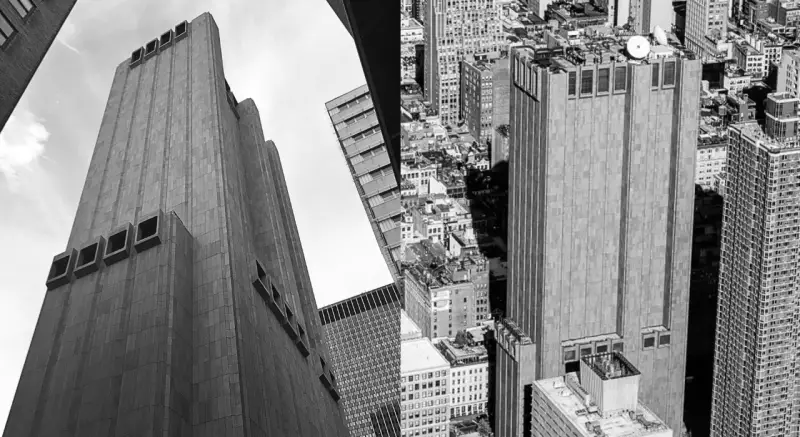
In the heart of Lower Manhattan, where glass towers compete for breathtaking views, stands a bizarre architectural anomaly that defies all conventions. At 33 Thomas Street, a massive 550-foot concrete monolith rises like a silent sentinel, featuring no windows, no visible signs of life, and no immediate explanation for its fortress-like appearance.
The Building That Captured Public Imagination
Recent social media attention has brought this mysterious structure back into the spotlight. When a video about the building resurfaced on Reddit, it reignited longstanding questions about what exactly happens inside this imposing concrete block. The curiosity isn't limited to ordinary citizens either - even Hollywood superstar Tom Hanks expressed his bewilderment back in 2017 when he posted a photo on X (formerly Twitter) calling it "the scariest building I've ever seen!"
From street level, the building offers no clues about its purpose. The blank granite walls and sparse ventilation openings create an aura of secrecy that has fascinated New Yorkers and visitors alike for decades. Despite its ominous appearance, this isn't some abandoned relic or avant-garde art installation - it serves a very specific, functional purpose that dates back to the pre-internet era.

Architectural Fortress Built for Communications
Known officially as the AT&T Long Lines Building, 33 Thomas Street was constructed in the 1970s with a clear mission: to house massive switching equipment for long-distance telephone traffic. In an era before digital technology dominated communications, these systems required exceptionally tall floors and incredibly strong structural support to handle the heavy machinery needed for routing calls across the country.
The building's unique design features 29 floors with 18-foot high ceilings, giving it the appearance of a 40-story skyscraper while technically containing fewer levels. According to historical records, AT&T commissioned architect John Carl Warnecke to design the structure as a veritable fortress, capable of withstanding a nuclear blast and continuing operations for up to two weeks afterward.
To achieve this remarkable durability, the building incorporated thick concrete walls, internal fuel and water reserves, and independent power supplies. Windows were deliberately omitted - they served no purpose for the machines inside and would have created structural vulnerabilities in a doomsday scenario.
Modern Function and Nationwide Network
While AT&T shifted most of its long-distance traffic management elsewhere around 1999, the building never became obsolete. It continues to host telecommunications infrastructure and high-security data-center operations, now commonly referred to simply by its address rather than its original corporate name.
The recent wave of interest gained momentum when TikTok creator Eric Guidry (@e.guidry) posted a video explaining the building's purpose within AT&T's historic "long lines" network. His analysis identified similar windowless structures in San Francisco, Chicago, and Austin, describing them as part of a coordinated network of central switching and routing hubs strategically placed in major population centers.
Guidry emphasized that these facilities were built specifically for machines rather than people, eliminating the need for windows or natural light. He also noted that 33 Thomas Street remains one of the most secure towers globally, designed for autonomous operation and built with survivability as a primary concern, including potential nuclear strikes.
Surveillance Controversies and Enduring Mysteries
The secretive nature of these facilities has inevitably attracted scrutiny from journalists and civil liberties organizations. Online publication The Intercept has reported that multiple AT&T buildings across the United States, including the one at 33 Thomas Street, have played roles in NSA surveillance programs.

These reports, based on whistleblower disclosures and anonymous sources, describe AT&T as a crucial private-sector partner in large-scale data collection initiatives. The volume of communications traffic flowing through hubs like 33 Thomas Street makes them particularly valuable for intelligence agencies, as they represent choke points where phone calls and internet connections converge.
AT&T has historically maintained that it complies with lawful government requests while refusing to comment specifically on security partnerships. The NSA similarly doesn't confirm involvement with particular sites, leaving much of what potentially occurs inside these buildings in the realm of speculation and investigative reporting.
Why This Building Captivates Us
The enduring fascination with 33 Thomas Street stems from both visual and psychological factors. In a city where skyscrapers proudly display their interiors and views, this structure remains completely opaque - no office workers visible in windows, no evening lights, no hints of human activity. It presents itself purely as infrastructure rather than workspace.
Psychologically, the building sits at the intersection of several contemporary anxieties: mass surveillance concerns, critical but invisible digital infrastructure, and the realization that modern life depends on systems we never see. It functions both as a practical telecommunications facility and as a potent symbol of something larger and more secretive.
While the building continues to spark speculation and curiosity, one thing remains certain: 33 Thomas Street stands as one of the few skyscrapers in New York that invites mystery precisely because it reveals nothing at all. Whether it's merely a relic of telephone architecture, a crucial data routing hub, or part of surveillance infrastructure, its true nature remains as impenetrable as its concrete walls.