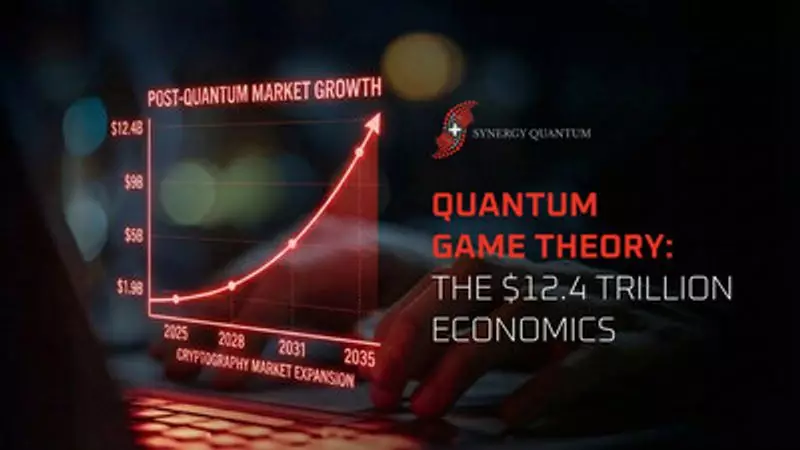
The world is on the brink of a $12.4 trillion economic crisis, not from a market crash, but from the silent, relentless march of quantum computing. A new report, "The Quantum Game Theory: The $12.4 Trillion Economics Crisis" by Dr. Jane Thomason and her team, sounds a dire alarm. It warns that the foundational encryption protecting our global digital economy could be shattered by quantum computers as soon as 2028, triggering unprecedented financial and security chaos.
The Impending Quantum Deadline and the Global Scramble
The core of the crisis lies in a fundamental shift in computational power. Today's digital world—from online banking and state secrets to cryptocurrency wallets and personal data—is secured by complex mathematical encryption. This encryption, considered unbreakable by classical computers, forms the bedrock of trust in the digital age. However, quantum computers operate on entirely different principles, using quantum bits or qubits. This allows them to perform specific calculations, like the ones underpinning current encryption, at speeds unimaginable today.
The report highlights a critical deadline: 2028. This is the year by which experts predict quantum computers could achieve "cryptographic relevance"—the power to break widely used encryption standards like RSA and ECC. The potential fallout is staggering, putting an estimated $12.4 trillion in digital assets at immediate risk. In response, a global race is underway. Nations are pouring billions into quantum research, not just for offense but for defense. The United States, China, and the European Union are leading massive initiatives to develop quantum-resistant cryptography—new encryption methods that can withstand quantum attacks.

India's Strategic Position and the Call for Action
For India, a nation undergoing rapid digital transformation with initiatives like Digital India and a booming fintech sector, the quantum threat is particularly acute. The country's vast digital infrastructure, Aadhaar database, financial networks, and growing stock of digital assets are all potential targets. The report positions the current era as a "quantum game theory" scenario. Countries and corporations are making high-stakes bets: investing in quantum computing capabilities while simultaneously trying to shield themselves from the same technology developed by rivals.
The economic implications are profound. Sectors most reliant on long-term data security are the most vulnerable:
- Banking & Finance: Transactions, loans, and market data could be decrypted.
- Government & Defence: Classified communications and citizen data face extreme risk.
- Healthcare: Protected patient records could be exposed.
- Blockchain & Cryptocurrency: The integrity of digital ledgers and wallets could be compromised.
This isn't a distant sci-fi scenario. The "Harvest Now, Decrypt Later" strategy is already a recognized threat. Adversaries are likely harvesting encrypted data today, storing it with the intent to decrypt it once quantum computers are powerful enough, rendering current privacy measures useless retroactively.
The Path Forward: Building Quantum Resilience
The solution lies in a urgent, coordinated transition to post-quantum cryptography (PQC). This refers to new cryptographic algorithms designed to be secure against both classical and quantum computer attacks. Standard-setting bodies like the National Institute of Standards and Technology (NIST) in the US are already in the final stages of selecting these new global standards. The report emphasizes that the transition is a massive, complex undertaking that will require updating software, hardware, and protocols across every layer of the digital ecosystem.

The message for policymakers and business leaders in India and globally is clear: the clock is ticking. Investment in quantum research and the systematic migration to quantum-resistant frameworks must be treated as a national and economic security priority. The $12.4 trillion figure is not just a valuation of assets at risk; it represents the potential cost of inaction in the face of the next great technological disruption. The quantum game has begun, and the moves made in the next few years will determine the winners and losers in the new digital world order.