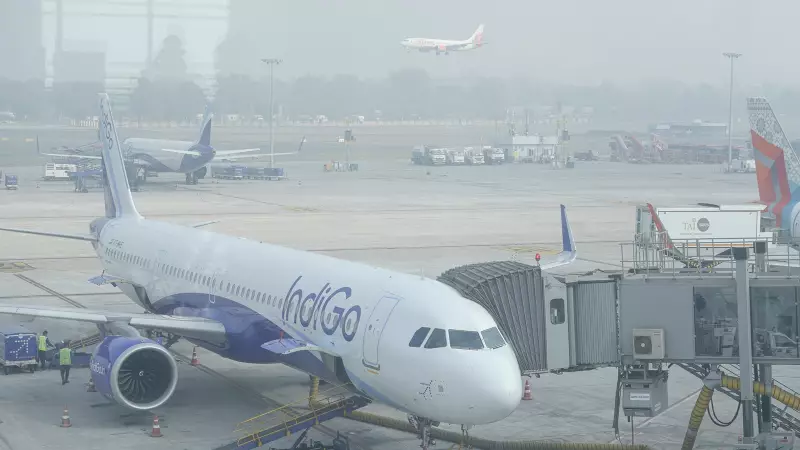
The Indian government has informed Parliament about a series of incidents involving the manipulation of Global Positioning System (GPS) signals, known as spoofing, and interference with Global Navigation Satellite System (GNSS) signals at several major airports across the country. The issue, which poses a potential threat to aviation safety, has prompted authorities to seek specialized help to trace the source of these disruptions.
Incidents Across Major Hubs
In a written statement to the Rajya Sabha on Monday, Civil Aviation Minister K K Rammohan Naidu confirmed that flights in the vicinity of Delhi's Indira Gandhi International Airport (IGIA) reported GPS spoofing incidents. These occurred specifically while aircraft were using GPS-based procedures to approach Runway 10. The minister clarified that contingency plans were successfully activated and there was no impact on flight movements, especially on other runways equipped with conventional navigation aids.
Beyond Delhi, the government is receiving regular reports of similar spoofing and GNSS interference from other key airports. Kolkata, Amritsar, Mumbai, Hyderabad, Bangalore, and Chennai have all submitted such reports. This follows a 2023 mandate by the Directorate General of Civil Aviation (DGCA) making it compulsory for all such incidents to be reported.
Government Mobilizes to Identify Source
To tackle this growing concern, the Airports Authority of India (AAI) has sought assistance from the Wireless Monitoring Organization (WMO), an agency under the Ministry of Communications' Wireless Planning & Coordination Wing. The WMO's expertise in spectrum management is being leveraged to "possibly identify the source of interference/spoofing."
Minister Naidu revealed that during a high-level meeting on the issue, the WMO was directed to mobilize additional resources. This effort will use approximate spoofing location details provided by the DGCA and AAI to pinpoint the origin of the counterfeit signals.
GPS spoofing involves transmitting fake signals to deceive an aircraft's navigation systems, potentially leading to incorrect position, timing, and navigation data. Jamming or interference, on the other hand, typically involves overpowering legitimate satellite signals with strong radio noise. Such incidents have been increasing globally, often near conflict zones.
Safety Protocols and Cybersecurity Measures
In response to the recent spike in incidents around Delhi in November 2025, the DGCA issued a directive on November 10 requiring airlines, pilots, and air traffic controllers to report any GPS or GNSS anomalies within 10 minutes of occurrence. This is aimed at maintaining flight safety and operational integrity.
Naidu assured Parliament that India retains a Minimum Operating Network (MON) of conventional ground-based navigation and surveillance infrastructure as a backup, in line with global best practices. The country is also participating in international forums to stay updated on the latest mitigation technologies and methodologies.
On the broader front of aviation cybersecurity, the minister stated that the AAI is implementing advanced security solutions for its IT networks to guard against global threats like ransomware and malware. These actions follow guidelines from the National Critical Information Infrastructure Protection Centre (NCIIPC) and CERT-In, with measures being continuously upgraded as threats evolve.