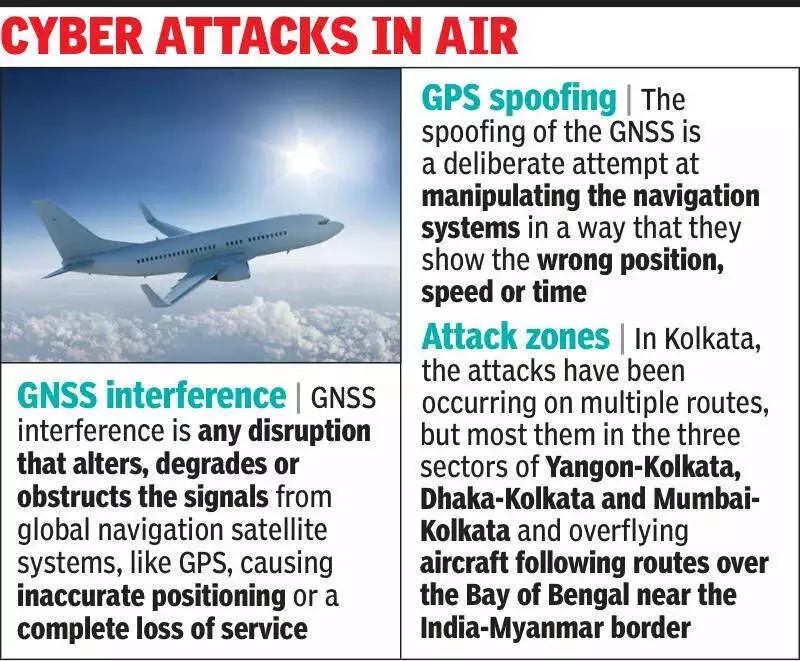
In a serious threat to aviation safety, the Kolkata Flight Information Region (FIR) has witnessed a surge in cyber attacks targeting aircraft navigation systems. A senior official revealed on Tuesday that more than 100 instances of such attacks have been reported in the past two months, impacting an average of two to three flights every day.
Nature of the Cyber Threat: GNSS Jamming and Spoofing
The attacks primarily involve interference with the Global Navigation Satellite System (GNSS) signals. This leads to a loss of crucial Positioning, Navigation, and Timing (PNT) data for aircraft. In more malicious cases, attackers employ GPS spoofing, a technique that feeds false location data to the aircraft's navigation system. This can mislead pilots about the plane's actual position, potentially causing it to deviate from its assigned flight path. "Unless checked, it can even lead to an accident," the official warned.
Civil Aviation Minister Kinjarapu Rammohan Naidu confirmed on Monday that spoofing incidents have been detected not just in Kolkata, but also at major airports including Delhi, Mumbai, Amritsar, Hyderabad, Bengaluru, and Chennai.

Critical Sectors and Pilot Vigilance
Within the Kolkata FIR, the disruptions have been concentrated on specific routes. The most affected sectors are:
- Yangon-Kolkata
- Dhaka-Kolkata
- Mumbai-Kolkata
Aircraft overflying the Bay of Bengal near the India-Myanmar border have also reported issues. The problem typically arises around the edge of the Kolkata FIR during the handover of flight control from Yangon or Dhaka Air Traffic Control (ATC) to Kolkata ATC.
Pilots operating in these zones have had to maintain heightened alertness. They must constantly verify that the course set by the flight management computer hasn't been altered by surreptitiously fed false information. Veteran pilots describe the interference as coming from artificially generated signals that overpower legitimate ones, causing errors or a complete blackout of PNT data.
ATC Countermeasures and Backup Systems
In response, air traffic controllers in Kolkata have intensified their monitoring. They now keep a hawk eye on flights along defined paths, watching for any deviations indicative of spoofing. When a discrepancy is spotted, controllers immediately contact the aircraft to provide correct coordinates.
Where radar coverage is available, Kolkata ATC offers direct navigational guidance to help pilots re-establish their correct route. Additionally, the region is equipped with a backup radio navigation system known as VHF Omnidirectional Range (VOR). Ground-based VOR beacons in cities like Kolkata, Jamshedpur, Patna, Ranchi, and Bhubaneswar allow aircraft to determine their bearing without relying on GPS, providing a crucial failsafe. Airport officials confirm they guide affected flights to use these VOR signals to bypass the spoofed GPS data.
The situation underscores a growing and sophisticated threat to modern aviation, where reliance on digital navigation makes aircraft vulnerable to cyber intrusions. The repeated incidents over two months highlight the urgent need for robust, multi-layered defensive systems to ensure passenger safety remains uncompromised.