Learning is no longer confined to classrooms and libraries in today's fast-paced world. People constantly acquire new knowledge by reading articles, watching videos, attending online classes, and more. While this has made information more accessible, it has also introduced challenges. Many individuals accumulate vast amounts of information but struggle to apply it in real life, leading to confusion, overthinking, and difficulty in decision-making.
Traditional Wisdom on Learning
Traditional wisdom views learning differently. It emphasizes not just facts but also understanding and experience. Chinese proverbs, known for their simplicity and depth, often convey practical insights. One such proverb highlights the importance of interpersonal dialogue in the learning process.
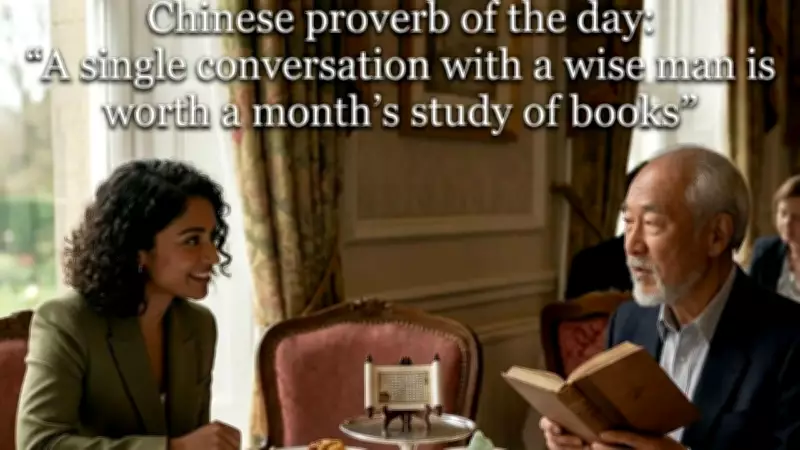
Chinese Proverb of the Day: "A single conversation with a wise man is worth a month's study of books."

Why This Proverb Focuses on Wisdom, Not Just Knowledge
The saying draws a clear distinction between wisdom and knowledge. Knowledge is acquired from books, classes, and other information sources. It is organized, detailed, and often theoretical. Wisdom, on the other hand, comes from experience, observation, and practical understanding.
A wise person is not merely someone who has read many books but someone who has lived through experiences, made decisions, learned from mistakes, and grown wiser over time. When such a person shares their insights, they often simplify complex ideas and connect them to real-life situations. This is why one conversation can sometimes clarify more than hours of reading.
What Makes Conversations More Impactful Than Reading
Reading is typically a one-way street. You receive information but cannot ask questions or explore deeper. Conversations, however, are two-way interactions. They allow people to ask questions, voice concerns, and see things from different perspectives.
When someone talks to a knowledgeable or experienced person, the learning becomes more tangible and applicable. If the conversation addresses specific issues, the advice becomes even more useful. This interaction also enhances memory retention. People often remember conversations better because they are tied to real-life events and emotions.
Learning from Experience in Everyday Life
Much of what we learn in life does not come from books. It comes from real-life situations such as making decisions, dealing with people, or facing problems. Those who have been through such experiences often possess knowledge that goes beyond theory.
For instance, someone starting a new job might read about workplace etiquette, but advice from a more experienced colleague can provide practical tips that are easier to apply. Similarly, guidance from elders is often valuable because it is based on their lived experiences. The proverb underscores that learning is more effective when connected to real life.
How This Idea Applies in the Modern World
Today, people are surrounded by information. From productivity tips to career advice, content is abundant. However, having more information does not always lead to better understanding.
This is where the proverb becomes relevant. It encourages focusing on meaningful learning rather than merely consuming more content. Seeking advice from mentors, experts, or those with firsthand experience can help navigate the information overload. This is often seen in workplaces through mentoring and collaboration, where people learn not just from manuals but from conversations and shared experiences.
The Role of Guidance in Personal and Professional Growth
Advice plays a crucial role in decision-making and personal development. A wise person can help others avoid mistakes and progress more efficiently. In personal life, advice from someone who has faced similar challenges can provide clarity during tough times. In the professional realm, guidance can assist with career planning, skill development, and problem-solving.
The proverb reminds us that learning does not always require a long time. Sometimes, a timely conversation can make a significant difference.

Finding the Right Balance Between Reading and Interaction
The proverb does not dismiss the value of books. Reading remains an excellent way to learn. However, it suggests that reading alone may not be sufficient. The best approach is to find a balance. Books provide foundational knowledge, while discussions deepen understanding. Learning becomes more comprehensive when both methods are used.
Reading about a subject helps build understanding, and discussing it with an expert helps apply that knowledge effectively.
Why This Proverb Still Holds Value Today
Despite advances in technology and education, the need for human interaction in learning persists. People continue to benefit from conversations, advice, and shared experiences. The proverb remains relevant because it addresses a common problem: many people prioritize information accumulation over true understanding.
It offers a practical solution by encouraging meaningful conversations. It shows that learning is not just about how much you know, but about how well you understand it.
A Simple Takeaway from This Chinese Proverb
This saying carries a clear and useful message. It pushes people to look beyond books and learn through experiences and interactions. A single meaningful conversation can provide insights that might take weeks of reading to obtain. This does not diminish the value of books; rather, it highlights the importance of using diverse learning methods.
The Chinese proverb, "A single conversation with a wise man is worth a month's study of books," is a timeless lesson about learning and understanding. It emphasizes that while information is important, true understanding often comes from action and interpersonal exchange. Taking the time to learn from others can make a significant difference in a world full of information. By combining reading with meaningful conversations, people can learn more effectively, make better decisions, and grow more efficiently. The idea is simple but powerful: when knowledge and wisdom come together, real learning occurs. Wisdom often stems from genuine connections with others.