White House Official's AI Remarks Spark Debate on India's Sovereign Tech Future
Artificial intelligence has firmly entrenched itself into India's daily news cycle, sparking intense discussions from policy corridors in Delhi to the bustling offices of startups nationwide. A central question echoes across these conversations: how should India strategically build its AI future? Amid this critical national dialogue, a speech delivered at the India AI Impact Summit has catapulted to the forefront of attention, igniting a fiery debate.
The Remarks That Ignited a Storm
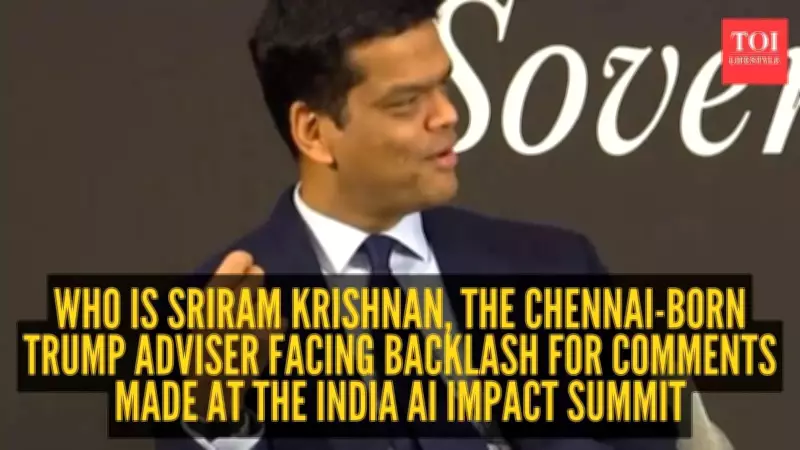
At the India AI Impact Summit in New Delhi, Sriram Krishnan, a Chennai-born tech investor and White House official, addressed the global AI ecosystem. He highlighted the massive scale of United States investments in artificial intelligence, emphasizing a vision for international collaboration built upon American infrastructure.
"We want to make sure that the world uses the American AI stack... we want to make sure that the world uses our AI models, and third, it uses our applications and builds applications on top. We want to make sure we are amazing and easy to do business with," Krishnan stated, as reported by ANI.

Directly addressing India in the context of sovereign AI, he elaborated, "For India, we have this conversation about what sovereign AI actually means. When we think about it, America is going to have a minimum of $600 billion in investments across areas, and it is going to power AI training runs, data centers, and compute. We think all of our allies, and India is a key ally, should be leveraging and building on top of this infrastructure. This does not mean giving up on strategic autonomy. Indian companies will need to bring in local language support and culture."
These comments arrived at a particularly sensitive juncture, as India is actively formulating its own comprehensive AI strategy, amplifying their impact and sparking immediate reactions.
Indian Founders Voice Strong Reactions
The Indian startup community responded with vigor and concern. According to a Hindustan Times report, Zoho founder Sridhar Vembu shared a pointed perspective, writing, "This is why brain drain is costly and we must fight hard to retain the next generation of talent in India."
Echoing this sentiment, Capitalmind founder and CEO Deepak Shenoy emphasized the imperative for India to develop its own foundational capabilities. He was quoted stating, "India should and will build foundational models, and in general, we need things that cannot be denied to us if America doesn't like us."
From Chennai to the Global Tech Arena
Sriram Krishnan's journey from Chennai to influential global tech circles adds depth to the controversy. A graduate of SRM Valliammai Engineering College in Tamil Nadu, he began his career at Microsoft, contributing to Windows Azure APIs and services.
His career trajectory includes significant roles at Facebook, where he helped expand the mobile app advertising business, followed by positions at Snap and Twitter (now X), where he collaborated with Elon Musk during a major restructuring phase. In 2021, he ascended to the role of general partner at the venture capital firm Andreessen Horowitz, later spearheading the firm's inaugural international office in London.
The Broader Question of AI Sovereignty
The controversy surrounding Krishnan's remarks underscores a much larger and pressing issue. As India hosts summits like the India AI Impact Summit and intensifies its focus on sovereign AI, there is a growing and resolute interest in cultivating independent AI models and robust infrastructure.
The reactions from prominent founders clearly indicate a widespread belief that India must prioritize the creation of its own foundational systems to ensure long-term security, economic growth, and technological self-reliance.
This debate is poised to continue and intensify. Artificial intelligence is fundamentally reshaping global economies and policy frameworks. In India, the discourse around sovereign AI and the dynamics of international partnerships is becoming increasingly serious and pivotal for the nation's future trajectory.