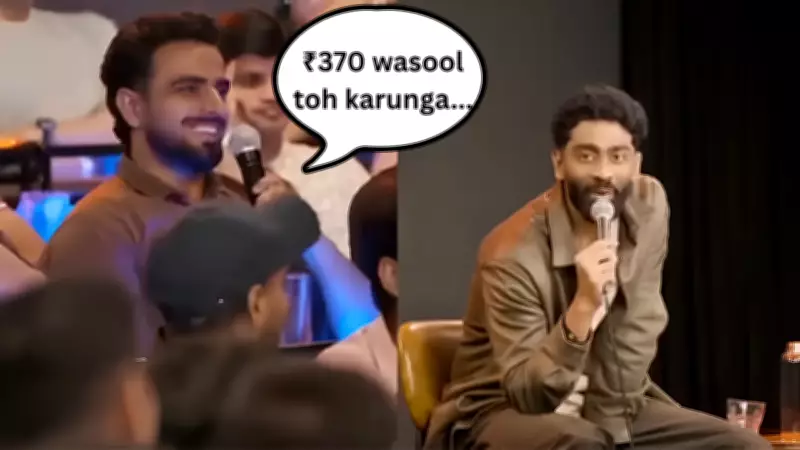
Another day, another viral clip, and another joke that was never really a joke. The internet is buzzing over a recent episode of stand-up comedian Pranit More's show, where a man shared his dating experience. In the now-viral clip, he described visiting a local market with a woman and ordering chicken biryani, with the bill totaling around Rs 360-370. So far, it sounded like an ordinary dating story. Then came the punchline: after the meal, the woman asked him to drop her home. Recalling his response, he told the audience, 'Maine kaha yaar 370 rupaye lage hai, wasool toh karunga' (I have spent 370 rupees, I am going to get my money's worth). The audience erupted in laughter, and host Pranit More laughed along, calling it a 'Peak Gurgaon moment.'
Outrage Over Normalized Misogyny
However, for many women watching, there was nothing funny about it. The joke carried an idea that women have been dealing with for generations: that if a man spends money on a woman, she somehow owes him something in return. A meal becomes a down payment, basic decency is an investment expecting returns, and consent has a price tag. In 2026, this is still being sold as comedy. What sparked outrage was not just the story itself, but the fact that no one on stage seemed to find anything wrong with it.
Another Viral Clip: Ashish Chanchlani
Before that controversy could settle, another clip surfaced featuring popular YouTuber Ashish Chanchlani. In an Instagram story, he said: 'Ek baat batao, theatre mein jo horror movie dekhne aate hain, aur jo group mein ladke hote hain, wo ladkiyon ke saamne itna kyon bante hain. Tumhein kya lagta hai, wo karne se ladki raat mein tumko de degi? Nahi milega bhai nahi milega...' Again, women were the punchline, reduced to something men could potentially 'get' if they played their cards right. The clip spread quickly on Reddit's r/InstaCelebsGossip, where comparisons to the biryani incident were instant. One user wrote, 'Why is he talking like that guy from Pranit More's show?' Another user, u/True-Brain-3548, commented, 'Coming to realize that your favourite creator from childhood is a raging misogynist is like finding out that Santa isn't real.'

Women Are Not Surprised
The most telling part is that these viral moments do not land as shocking revelations for most women. They feel like deja vu. Women have heard these jokes in college, at office parties, at family get-togethers, on WhatsApp groups, and in casual conversations. The words shift, the faces change, but the core idea remains: a woman owes a man something if he spent money on her, her consent is negotiable or purchasable, and discussing her value casually is just regular guy talk. As long as everyone is laughing, none of it counts.
The 'Just a Joke' Defense
Right on time, the backlash to the backlash arrived. Critics say people are too sensitive nowadays and need to learn to take a joke. But jokes do not exist in a vacuum. Humor reflects the society it comes from. What a room laughs at reveals what is considered acceptable. What gets applause shows what behavior has been normalized. No one is arguing that comedy needs to be sanitized; the best comedy challenges authority and says uncomfortable things. But there is a difference between wit and plain disrespect with better delivery. When women are consistently the punchline, the prize, or the transaction, that is not dark comedy or dank jokes; it is misogyny with a mic.
Why These Viral Clips Matter
This is not about one comedian or one YouTuber making poor choices on camera. It is about incidents happening so regularly that we have lost count. When millions of people, many of them teenagers, consume the same ideas packaged as entertainment week after week, problematic ideas stop sounding problematic and start sounding like just the way things are. This slow normalization is where the damage happens. When women are consistently framed as prizes or transactions in popular content, that framing eventually bleeds into real conversations, real attitudes, and real behavior.

What Needs to Change
Several things need to change. Audiences must think about what they reward with their attention. Every share, view, and laughing emoji tells creators what is working. Sexist humor gets applause, so creators keep making it. Criticism matters, but it should target ideas, not turn into harassment campaigns against individuals. The point is to challenge what is being normalized. Creators with large audiences, especially those followed by young people, need to recognize the weight of their influence. They can be funny and bold without reducing women to objects. Young audiences should learn to ask one simple question about any joke: who is it targeting, and what idea is it reinforcing?
The bigger question is not why comedians keep making these jokes, but why audiences keep accepting them. Comedy can be clever without being degrading, sharp without being sexist. In a country where women fight daily for dignity, safety, and basic respect, humor can evolve beyond treating them as punchlines.