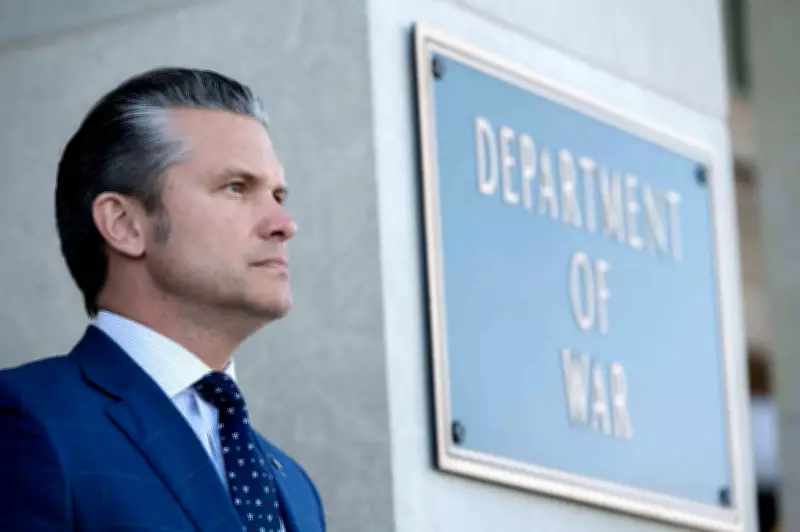
US Defense Department Clash with Anthropic Concludes with AI Defense Ban
The tense confrontation between the United States Department of Defense and the artificial intelligence firm Anthropic has reached a decisive conclusion. The AI company has been effectively banned from being utilized for defense-related purposes, following a period of intense pressure from the Pentagon. This outcome stems from a previously issued ultimatum where military officials threatened to employ a powerful, decades-old legal instrument against the technology company.
The Pentagon's Ultimatum and the Defense Production Act
Prior to this ban, the Pentagon explicitly threatened to invoke the Defense Production Act (DPA) against Anthropic. This law, which many younger Americans may be unfamiliar with, was central to the government's demands for unrestricted military access to Anthropic's advanced AI model, known as Claude. The DPA grants the federal government sweeping authority to direct private sector companies to meet national defense requirements, making it a formidable tool in such disputes.
Understanding the Defense Production Act
The Defense Production Act is a critical piece of legislation signed into law by President Harry S. Truman in 1950, during the supply shortages at the onset of the Korean War. Its primary function is to ensure that private industry can support national defense efforts during crises. Key provisions of the Act include:

- The presidential authority to require companies to prioritize government contracts deemed essential for national defense.
- Mechanisms to guarantee that the private sector produces sufficient quantities of materials needed by the military or government.
- Powers allowing the president to offer loans and incentives to boost production of critical goods.
- The ability to establish voluntary agreements with private industry to coordinate defense production.
Historical Applications of the Defense Production Act
The DPA has been invoked by multiple administrations throughout history, though its application to technology companies has been exceptionally rare. Past uses have predominantly focused on physical goods and supply chain crises:
- Both President Donald Trump and President Joe Biden utilized the Act to accelerate the production of medical supplies during the COVID-19 pandemic.
- President Biden employed the law in 2022 to address the baby formula shortage, speeding up domestic production and authorizing imports from overseas.
- In 2023, the Biden administration invoked the DPA to compel companies to share safety test results and other critical information with the government, though this order was later repealed by Trump at the start of his second term.
- Historically, the Clinton and George W. Bush administrations used the Act to ensure continuous electricity and gas supply to California utilities during an energy crisis.
- Following Hurricane Maria's devastation of Puerto Rico in 2017, the DPA was used to prioritize contracts for essential services like food, water, housing, and power restoration.
Why Using the DPA Against Anthropic Would Have Been Unprecedented
All previous applications of the Defense Production Act share a common characteristic: they were used to secure the supply of tangible, physical goods or to mandate information sharing. Employing it against Anthropic would have represented a dramatic departure, venturing into the realm of compelling a company to alter its core product's ethical framework.
If invoked in this context, the Pentagon could have forced Anthropic to modify the Claude AI model by removing its built-in safety restrictions or stripping ethical limitations from its contractual language. This would have effectively mandated the company to produce a version of its AI that it considers potentially unsafe or unethical, raising profound questions about corporate autonomy and technological governance in defense contexts.

The final resolution—a ban on Anthropic's technology for defense purposes—highlights the complex intersection of national security, artificial intelligence ethics, and governmental authority. It underscores the ongoing debate about how legacy laws like the Defense Production Act apply to modern technological innovations and the boundaries of state power in the digital age.