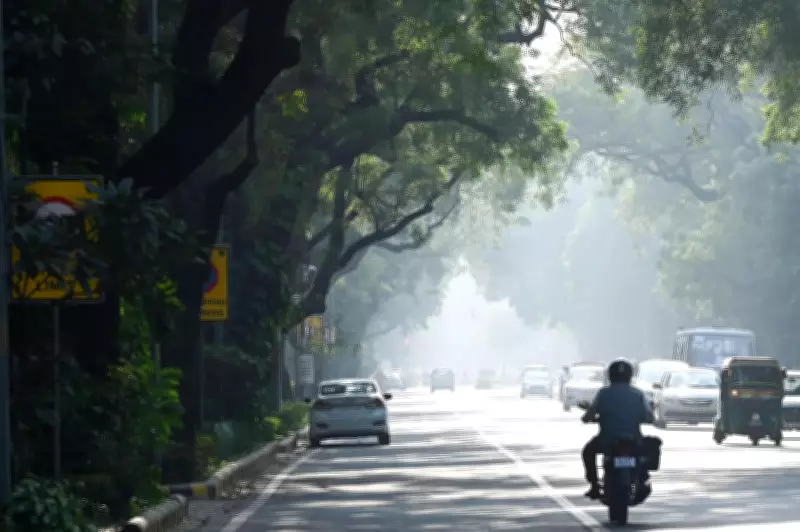
A new study by researchers at IIT Gandhinagar (IIT-Gn) suggests that simply planting more trees may not be sufficient to cool Indian cities that are grappling with rising temperatures. While urban cooling plans often emphasize greening as a key strategy, the study highlights that the effectiveness of tree cover depends on various factors such as humidity, airflow, urban density, and climate type.
Study Scope and Methodology
The research, published in the journal Nature Communications, analyzed 138 Indian cities from 2003 to 2020 across diverse climate zones, including tropical savannah, semi-arid steppe, and humid subtropical regions. The team, comprising Angana Borah, Adrija Datta, Ashish S Kumar, Raviraj Dave, and Udit Bhatia, reconstructed the 'Heat Index'—a metric that combines temperature and humidity to reflect how heat is experienced by the human body—rather than relying solely on land surface temperature.
Key Findings
The study found that while tree cover and vegetation generally help lower temperatures, the benefits are not uniform. In dry cities, vegetation can provide strong cooling effects, but in humid and compact neighborhoods, planners must also consider airflow and moisture build-up. Udit Bhatia, associate professor at IIT-Gn, stated, "Greening is essential for climate adaptation, and shade gives people immediate relief. But one-size-fits-all plantation targets do not address the entire problem."

Co-author Angana Borah emphasized, "The key question is not just about planting more trees, but about understanding which type of greenery is suitable, where it should be planted, and how much is needed." The researchers recommend integrated urban cooling plans that include parks, roadside plantations, open spaces, shade trees, and ventilation corridors.
Data and Analysis
Using multiple satellite datasets and urban indicators—including vegetation indices, canopy density measurements, local climate zone mapping, and night-time light data—the team employed explainable artificial intelligence methods to generate one-kilometer Heat Index maps. These maps identified urban features associated with heat stress across Indian cities. The study found that vegetation cover and canopy density were generally linked to lower Heat Index values once greenery exceeded certain thresholds. However, in highly humid, densely packed urban areas, extremely high canopy activity could worsen heat discomfort by trapping humidity.
Implications
The researchers concluded that better-designed urban greening plans could significantly reduce long-term heat vulnerability for millions of people living in rapidly warming Indian cities. The study underscores the need for tailored greening strategies that account for local climate and urban morphology, rather than applying a blanket approach.