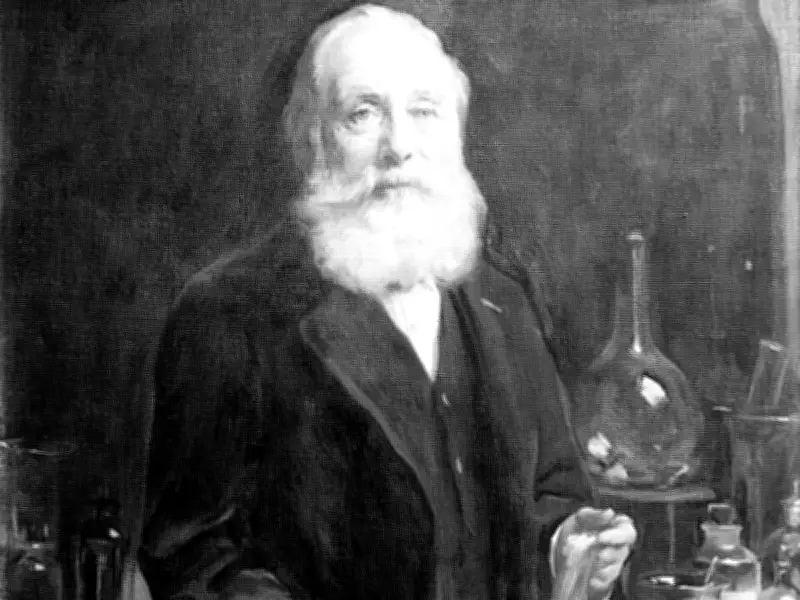
In 1856, an 18-year-old chemistry student named William Henry Perkin was conducting experiments in his home laboratory in London. His goal was to synthesize quinine, a drug used to treat malaria. However, one particular experiment did not go as planned. Instead of quinine, the reaction produced a strange, dark-colored stain. When Perkin cleaned the container with alcohol, he noticed that the deposit turned into a vibrant purple solution.
The Discovery of Mauveine
This accidental observation led to Perkin's discovery of mauveine, the first synthetic dye. After further testing, he found that the new compound could effectively stain fabrics in rich shades of purple. His research, later published in the journal Molecules, detailed how the dye successfully colored textiles.
Key Features of Mauveine
Before Perkin's breakthrough, most textile dyes were extracted from natural sources such as plants, insects, or minerals. These natural dyes were expensive and often inconsistent in quality. Mauveine was a game-changer because it was synthesized from coal-tar products, which were abundantly available due to industrialization. According to the Royal Society of Chemistry, mauveine became the first industrially profitable synthetic organic dye. It was not only a scientific curiosity but also a commercially viable product that could be mass-produced and sold.

From Lab to Market
Shortly after his discovery, Perkin filed a patent for mauveine and founded a factory to produce the dye. According to the University of Chicago Library, he quickly ventured into the dye-making industry, demonstrating that chemistry could be directly applied to industrial processes. Mauveine was widely used in clothing production across Europe and the United States. The color mauve became a fashion trend, embraced by the world of fashion.
The Chemistry Behind Mauveine
Although the discovery of mauveine is often described as a happy accident, its chemistry is more complex. Research shows that mauveine is not a single pure substance but a mixture of phenazinium derivatives. According to the Royal Society of Chemistry, these compounds contribute to the stability of its vibrant hues. This fact highlights that early chemical innovations were more empirical than modern formulations. Other studies indicate that the dye was produced through oxidation reactions using aniline, a coal tar byproduct. Thus, the discovery involved both luck and practical chemical techniques.
The Dawn of the Synthetic Dye Industry
The discovery of mauveine had far-reaching consequences. It marked a turning point for the chemical industry, which shifted toward synthetic chemistry. Various sources state that Perkin's discovery was the birth of the synthetic dye industry. This progress led to advances in many fields, including synthetic chemistry, which later influenced industries such as pharmaceuticals, plastics, and cosmetics. Synthetic colorants eventually found applications in paints, inks, and other products. Perkin's invention provided the foundation for linking laboratory research with mass manufacturing.
Why Mauveine's Discovery Still Matters
While the story of Perkin's discovery often emphasizes luck, historians stress the importance of observation. Every experiment can result in failure, but sometimes it leads to a breakthrough. What set Perkin apart was his decision to investigate the unusual result. Historical studies of scientists reveal that innovation often requires recognizing the potential of unintended outcomes. Perkin's findings demonstrated that young people could make significant contributions to science. Indeed, mauveine was the first artificial dye, playing a key role in developing an entirely new industry and proving that laboratory research could produce useful products for everyone.