Rethinking Time: From Linear Flow to Elastic Dimension
Time has long been regarded as the ultimate democratic constant, with every individual supposedly allotted the same 24 hours regardless of status or geography. However, this notion is a statistical illusion, as anyone facing a tight deadline or enduring a flight delay can attest. Time does not flow uniformly; it stretches, contracts, and sometimes seems to stand still, revealing its true elastic nature.
The Tesseract: A Gateway to Higher Dimensions
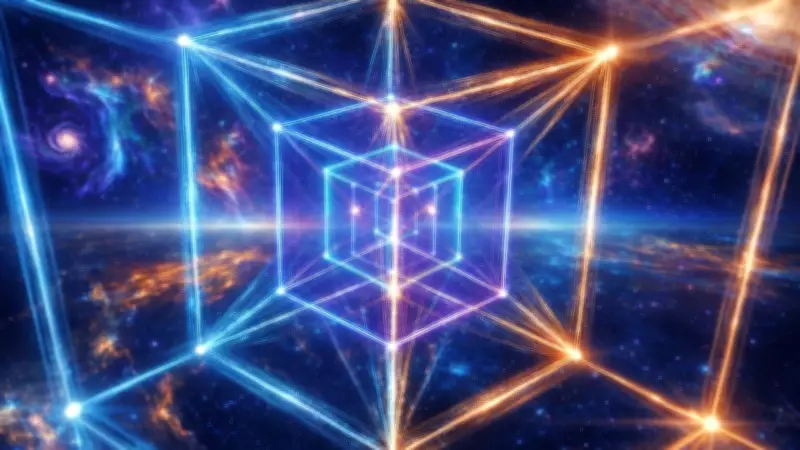
To comprehend this elasticity, we must first visualize the 'Metric of Trust' we place in our three-dimensional reality. We navigate length, width, and height with confidence, yet remain blindsided by the fourth dimension: time. Here, the tesseract serves as a perfect intellectual anchor. A tesseract is to a cube what a cube is to a square—a four-dimensional hypercube. While we can only perceive its 'shadow' in our world, often depicted as a haunting cube-within-a-cube, it represents a direction of movement beyond our physical reach. This geometric form proves there is 'more' to existence than what our senses report.
If we could step into the corridors of a tesseract, we might see the past and future not as distant memories or hopes, but as adjacent rooms in the same house. This concept challenges our linear perception, suggesting that all moments coexist simultaneously from a higher-dimensional perspective.

Carl Sagan's 'Contact': A Cultural Touchstone
Few works capture this 'preservation vs renovation' of reality better than Carl Sagan's 1985 novel, 'Contact', adapted into a 1997 Hollywood classic. In the story, protagonist Eleanor Arroway discovers that our three-dimensional existence is merely a thin skin stretched over a deeper complex. When she travels through the 'Machine', she isn't just moving across space; she traverses a landscape where the standard democratic contract of time is voided.
For observers on Earth, Ellie's journey lasts a mere fraction of a second, yet for her, it encompasses hours of wonder and conversation. Both accounts are objectively true, demonstrating that the time-horizon of an event depends entirely on one's dimensional vantage point. Time, it turns out, is less like a ticking clock and more like an accordion played by a musician who ignores the metronome.
Flatlanders of Time: Our Limited Perspective
Sagan, a master of cosmic 'Stakeholder Logic', used homespun metaphors to bridge dizzying gaps. His famous demonstration involves slicing an apple horizontally: each disk represents a two-dimensional world where 'Flatlanders' are oblivious to slices above or below. Extending this logic, we realize we are the Flatlanders of time, inhabiting three dimensions while moving through the fourth like a needle on a record, convinced only the 'now' exists.
From a tesseract's perspective, the entire record exists simultaneously. The 'then' of the 1980s when Sagan wrote 'Contact' and the 'now' of the 2020s are not gone; they are simply different coordinates on a map we haven't learned to read. This insight suggests our daily struggles with time—alarms, aging, and pleas for 'five more minutes'—are local phenomena, byproducts of our limited viewpoint.
Mathematics and Cosmic Architecture
Sagan even proposed a 'Modest Proposal' regarding fundamental constants like the transcendental number pi. He speculated that calculating pi to a deep enough decimal point might reveal a non-random pattern—a circle of zeroes and ones—serving as a signature from a cosmic architect. This would prove the universe was built with intent, with mathematics bridging our three-dimensional limits to higher-dimensional realities.
Ultimately, this perspective offers comfort: somewhere in the cosmic architecture, yesterday is still unfolding and tomorrow is already settled. We are stakeholders in a long-lasting outcome we only see in cross-sections. When time feels like it's 'crawling', we aren't being poetic; we're glimpsing the fourth dimension's true, mischievous shape.
Note: This article expands on concepts from 'Tesseract: The Geometry of Truth', a production by The Times of India with concept and visualization by Meera Jain, highlighting the ongoing exploration of time and dimensions.