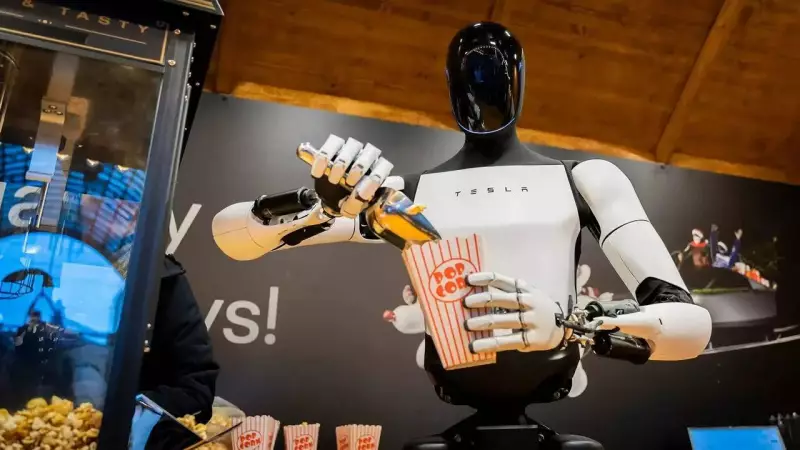
Elon Musk's grand vision for Tesla's Optimus humanoid robots to become the company's most vital product and a solution to poverty faces significant technical and practical roadblocks, a new investigation reveals. Despite the CEO's bold projections of millions of units and "infinite revenue," the robots are currently handmade, often remotely controlled, and far from ready for widespread deployment.
The Gap Between Vision and Reality
A detailed report from the Wall Street Journal (WSJ) suggests Optimus requires substantial development before it can replace humans on a large scale as Musk envisions. The report indicates that during public demonstrations, the robots are frequently teleoperated by human engineers wearing bodysuits and VR headsets rather than functioning independently. Each public appearance reportedly required a team of several engineers per robot to manage its movements and monitor performance.
Internally, Tesla engineers have struggled to create robot hands with human-like sensitivity and dexterity. Furthermore, some employees within Musk's companies have questioned the robot's immediate usefulness for routine business operations like manufacturing. Analysts find it challenging to value Tesla's humanoid robot plans due to the industry's nascency, often excluding it from financial forecasts.

Technical Hurdles and Commercial Skepticism
One of the most significant challenges cited is teaching Optimus to navigate indoor spaces safely without tripping or falling on people or pets. To gather training data, Tesla hired people to wear cameras and backpacks on 24/7 shifts. The company even trained robots to walk through Tesla offices, but they frequently toppled over, requiring engineers to pick them up.
This skepticism extends to investors. ARK Invest, notably optimistic about Tesla's stock, did not include Optimus in its 2029 estimates, as it does not expect the robot to be a successful commercial product until later. In an email to WSJ, ARK Invest director Tasha Keeney stated that initial versions will likely have a limited set of tasks, though she acknowledged Tesla's potential as a future competitor.
Competing Philosophies and Future Plans
Some competitors argue the humanoid form itself is problematic. Evan Beard, CEO of Standard Bots which sells wheeled robots, told WSJ that a legged robot is inherently unstable if power is cut, posing a safety risk. "For a factory, a warehouse or agriculture, legs are often inferior to wheels," he explained.
Despite abandoning its original factory deployment timeline and now working on a third-generation model, Musk's ultimate vision remains ambitious. In November 2025, he compared Optimus to a personal C-3PO or R2-D2, predicting it would become "the biggest product ever." However, Berkeley roboticist Ken Goldberg highlighted the core challenge: bestowing robots with human-like understanding and dexterity, a task where even a simple act like clearing a dinner table remains a formidable hurdle.