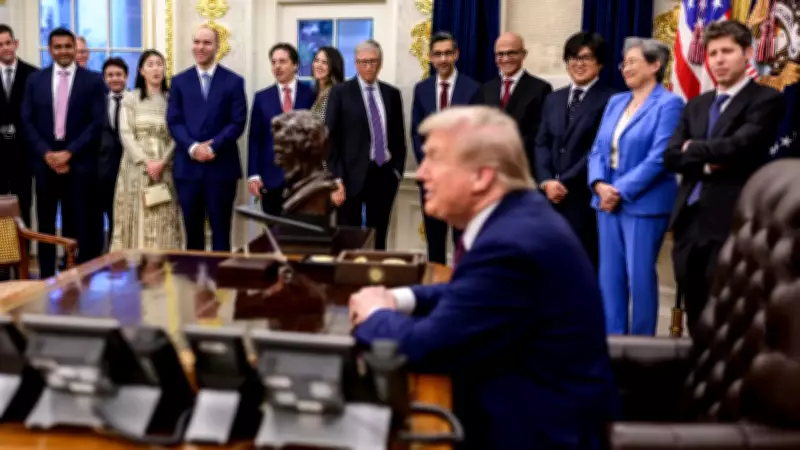
Trump Orchestrates Landmark Pledge to Protect Households from AI Energy Burden
In a significant move addressing growing public concern, US President Donald Trump hosted a high-profile gathering at the White House on Wednesday. Executives from leading technology firms—Google, Microsoft, Amazon, Meta, OpenAI, Oracle, and xAI—came together to formalize a "Ratepayer Protection Pledge." This voluntary commitment ensures these corporations will directly finance the substantial electricity demands of their artificial intelligence data centres, rather than shifting these expenses onto American households.
Addressing Public Perception and Rising Energy Prices
"They need some PR help because people think that if a data centre goes in there, electricity prices are going to go up," President Trump remarked during the event. He emphatically added, "It's not going to happen. And for the areas where it did happen, it won't happen anymore." This statement underscores the political urgency behind the pledge, as electricity prices have surged 6.3% over the past year, with data centres identified as a contributing factor.
The signing occurs against a backdrop of escalating energy costs and community unrest. According to the Labour Department's Consumer Price Index, consumer electricity prices have risen 6.3% year-on-year. A Bloomberg analysis reveals that in regions with significant data centre activity, monthly electricity costs have skyrocketed by up to 267% compared to five years ago. This has led to at least 25 proposed data centre projects being abandoned last year due to community protests, and Republican legislators in states like Missouri, Ohio, and Oklahoma are considering moratoriums or outright bans on new constructions.

Details of the Five-Point Pledge
The pledge formalizes commitments that some companies, including Microsoft, OpenAI, and Anthropic, had already made individually in recent weeks. Under the five-point agreement, the seven signatories commit to:
- Building, purchasing, or bringing their own power generation resources specifically for data centres, covering full costs regardless of usage.
- Paying for all necessary grid infrastructure upgrades, such as transmission lines, substations, and transformers, to prevent these expenses from appearing on residential bills.
- Negotiating separate electricity rate structures with local utilities and state governments, effectively isolating data centre costs from consumer pricing.
- Hiring and training local workers to support community employment.
- Making backup generation available during emergencies to avert blackouts and ensure grid stability.
At the event, Google President Ruth Porat highlighted the company's efforts, noting contracts to add over 7,800 megawatts of net new energy generation in Texas alone. Meta President Dina Powell McCormick announced a pilot programme in Ohio to train fibre technicians with guaranteed job placements. Amazon Web Services CEO Matt Garman cited existing rate agreements in Indiana, Louisiana, and Mississippi where the company covers 100% of its data centre energy costs while helping reduce bills for other customers.
Growing Energy Demands and Political Implications
The urgency of this pledge is magnified by projections of soaring electricity consumption. Data centres currently account for approximately 5% of US electricity usage, but this figure could escalate to 17% by 2030 as AI workloads expand, according to the Electric Power Research Institute. The International Energy Agency estimates that US data centre electricity demand will more than triple by 2035, increasing from 200 terawatt-hours to 640 terawatt-hours annually.
This exponential growth, coupled with an ageing grid where much transmission infrastructure is over 40 years old, has transformed energy affordability into a pivotal political issue as midterm elections approach. The pledge aims to alleviate voter concerns by demonstrating proactive measures to curb rising household costs.

Voluntary Nature and Expert Skepticism
Despite the high-profile ceremony, the pledge is non-binding and lacks federal penalties for non-compliance, as electricity pricing is primarily regulated at the state level. Ari Peskoe, Director of Harvard Law School's Electricity Law Initiative, criticized the initiative, stating, "The ratepayer protection plan is a show designed to sweep this issue under the rug." Environmentalists like Jill Tauber of Earthjustice echoed this sentiment, advocating for "strong policies and protections" over a signed pledge of uncertain legal value.
Administration officials, speaking anonymously to Politico, argued that tech companies would face accountability from local communities, emphasizing that all require extensive government approvals for large-scale facilities. One official noted, "We're not worried about people going rogue or cowboy on it." However, Wedbush Securities analyst Dan Ives warned that while the pledge addresses a political headache, it "creates a significant bottleneck with big tech organisations looking to build out large data centre footprints quickly."
Absences and Future Outlook
Anthropic was notably absent from the event, having been placed on a national security blacklist last week following a dispute with the Pentagon over ethical guidelines for military AI use. The company had previously pledged independently to cover 100% of grid infrastructure costs from its data centres.
President Trump acknowledged that lowering bills would "take a little time" but insisted prices would eventually decline. The real impact, however, hinges less on White House ceremonies and more on developments across 30 state legislatures, where over 300 data centre bills have been filed this year. As the nation grapples with balancing technological advancement and energy affordability, this pledge marks a critical step in corporate responsibility, yet its effectiveness remains to be seen in the evolving regulatory landscape.