Tata Chairman Declares AI as Technology Sector's Defining Opportunity
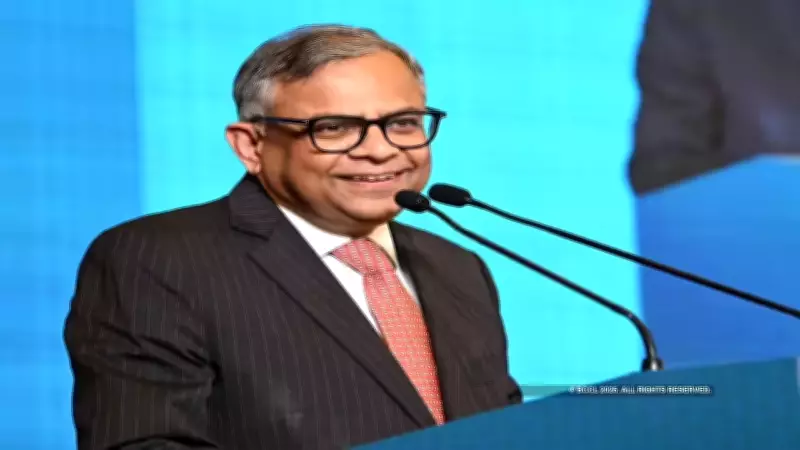
NEW DELHI: As artificial intelligence continues to redefine technological paradigms, Tata Sons chairman N. Chandrasekaran has positioned AI as the single most significant opportunity facing the technology industry today. Speaking at the India AI Impact Summit 2026, the veteran industry leader emphasized that this moment represents a fundamental shift in how enterprises will operate and compete globally.
The Core Value Proposition of IT in the AI Era
"Since I come from the IT industry, let me say one word about IT," Chandrasekaran stated during his keynote address. "In my opinion, this is the biggest opportunity for the technology sector and the IT industry." He elaborated that the true value of information technology lies not merely in technical implementation, but in its deep contextual understanding of enterprise business landscapes and technological ecosystems.
The Tata chairman explained that IT's unique advantage comes from its ability to integrate appropriate technologies within complex processes, supplier networks, customer relationships, and enterprise infrastructure stacks. According to his analysis, artificial intelligence dramatically expands this role, positioning IT organizations to embed AI agents directly into workflows, completely reimagine end-to-end processes, and drive transformation at unprecedented scale.

The Age of Abundant Intelligence and Scarce Resources
Chandrasekaran framed this technological shift within broader philosophical terms. "We are standing at a defining moment," he declared. "This is the age of abundant intelligence. The scarce resources now are trust, stewardship, and human capability."
In this emerging era, the Tata chairman argued that success will depend less on access to computational power or data volumes, and more on how responsibly intelligence is deployed, how thoughtfully it is governed, and how effectively human potential is amplified through technological augmentation. As India positions itself at the center of the global AI transformation, the Tata Group has developed a comprehensive, multi-layered strategy to capitalize on this opportunity.

Four-Pillar Strategy for AI Leadership
- Intelligence Infrastructure: "We have established India's first large-scale AI-optimized infrastructure for next-generation AI training and inference," Chandrasekaran announced. "I am happy to announce that we have partnered with OpenAI to build an initial 100-megawatt capacity, scalable to 1 gigawatt." This purpose-built AI compute infrastructure is specifically optimized for training and inference workloads. Additionally, the group has announced a collaboration with AMD to combine world-class architecture with Tata's infrastructure strength, engineering capabilities, and solutions expertise — creating sustainable, high-density AI capacity in India for global customers.
- Data Insights Platform: Beyond physical infrastructure, the second strategic pillar focuses on data. "We are building an AI data insights platform," Chandrasekaran revealed, explaining that it will be constructed on diverse Indian datasets layered atop foundational models to ensure intelligence reflects India's linguistic, cultural, economic, and sectoral diversity. "Intelligence must become accessible across the full diversity of Indian contexts," he noted, emphasizing the importance of representative data.
- Enterprise Transformation: The third pillar concentrates on enterprise-level transformation. Tata Consultancy Services and Tata Communications are jointly developing what Chandrasekaran described as an "AI operating system for industries." "We will create agentic, industry-specific solutions for every sector," he said, adding that these platforms will embed AI agents directly into workflows across multiple industries. "We are already well on this journey and will work with partners to launch and take these solutions to enterprises across the globe."
- Semiconductor Development: The final strategic pillar moves into semiconductor design and manufacturing. "Thanks to the Prime Minister's vision, we have made a serious foray into chips and semiconductors," Chandrasekaran stated. The next evolutionary step involves designing domain-centric, AI-optimized chips tailored for specific industries, beginning with automotive applications. "Our focus will begin with the automotive sector," he confirmed, aligning the group's semiconductor ambitions with the future of AI-driven mobility solutions.
This comprehensive approach positions the Tata Group at the forefront of India's AI revolution, combining infrastructure development, data strategy, enterprise solutions, and semiconductor innovation to capture what Chandrasekaran has identified as the technology sector's most significant opportunity in decades.