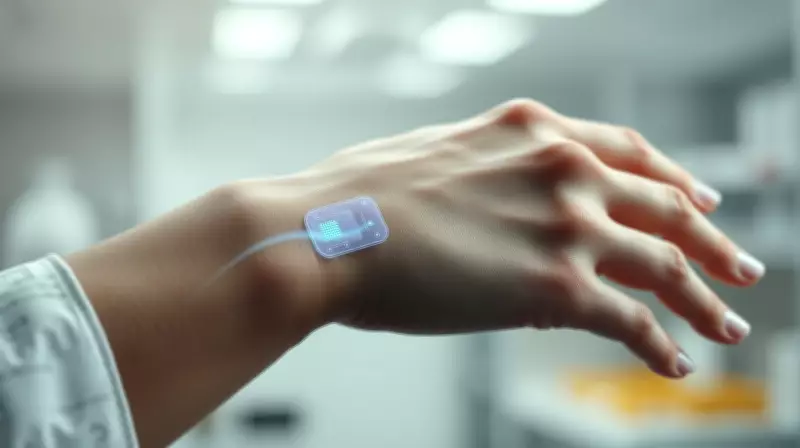
Scientists at the Pritzker School of Molecular Engineering at the University of Chicago have published a comprehensive review of one of the most ambitious frontiers in technology: stretchable neuromorphic electronics devices that are simultaneously soft enough to conform to human tissue, powerful enough to run artificial intelligence, and designed to learn and adapt in ways that mimic the biological brain. The review, published in the International Journal of Extreme Manufacturing, maps the current state of a field that is trying to solve a fundamental mismatch between human biology and modern computing hardware.
Why Rigid Silicon Fails the Human Body
Silicon chips are rigid and brittle. The human body is soft, wet, constantly flexing, and in continuous motion. Every attempt to permanently integrate conventional electronics with living tissue, whether for health monitoring, neuroprosthetics, or implantable AI, runs into this mechanical incompatibility, with real consequences: devices cause tissue irritation, lose signal contact, and fail under strain. The new class of soft neuromorphic systems is designed from the ground up to eliminate that conflict.
Conventional chips built from silicon can outperform humans on image recognition, cardiac analysis, and protein folding, but they are manufactured to be rigid and planar, optimised for the flat surfaces of circuit boards, not the curved, moving surfaces of organs and skin. When a rigid device is placed on a beating heart or a bending knee joint, the mechanical mismatch generates stress at the interface. Tissue responds with inflammation and scar formation. The device eventually delaminates, cracks, or loses the electrical contact it needs to function. This is why most implantable and wearable electronics today are either kept away from the body or replaced frequently.

Neuromorphic Computing: A Different Approach
Neuromorphic computing offers a different approach not just to how devices are built, but to how they process information. As a review on neuromorphic computing for biointegrated electronics explains, brain-inspired hardware carries inherent advantages for biomedical use: it processes information in parallel rather than sequentially, operates at extremely low power, and can adapt its computational state in response to incoming data properties that map closely onto what biological tissue actually needs from an embedded device.
How Soft Materials Replace Silicon
The key to making electronics that move like the body is replacing silicon with materials that share the body's mechanical properties. The University of Chicago review focuses on two primary material classes: flexible conjugated polymers and fluid-like ionogels, both of which transport charge through a mechanism called organic mixed ionic-electronic conduction. This is where the science becomes biologically interesting. Unlike a conventional metal wire, which moves only electrons, these soft materials move both electrons and ions simultaneously. Ions are charged atoms or molecules the same type of particles that biological neurons use to fire signals across synapses. By enabling ionic transport, these soft materials can electrochemically alter their internal state in response to incoming signals, building up or releasing charge in a way that changes their electrical conductivity over time.
The result is a transistor that does not merely switch between on and off states. It can hold a history of previous signals and modulate its response accordingly a direct analogue of synaptic plasticity, the biological mechanism by which neural connections in the brain strengthen with repeated use. A peer-reviewed study in Matter from the University of Chicago and Argonne National Laboratory demonstrated exactly this in practice, building an intrinsically stretchable neuromorphic device from a plastic semiconductor and gold nanowire electrodes that maintained full function when stretched to twice its original size, and correctly classified four types of cardiac signals with over 95 per cent accuracy.

Performance Numbers: 140% Stretch and Sub-0.5V Operation
The stretchability figures emerging from the latest generation of these devices are notable. Some components in the new architectures can stretch to 140 per cent of their resting length exceeding the natural stretchability of human skin, which stretches to around 130 per cent before experiencing stress. This means a device built on such a substrate could be worn on a joint that bends fully, or conformally wrapped around a curved organ, without the material losing its electronic function. Energy consumption is the other headline figure. By relying on electrochemical processes rather than large electron flows through metal conductors, these devices operate at voltages below 0.5 volts. For comparison, conventional silicon transistors in AI accelerators typically operate at voltages an order of magnitude higher. Research published in Nature Communications on neuromorphic hardware using two-dimensional materials demonstrated that brain-inspired circuit architectures can achieve energy efficiency two orders of magnitude beyond what silicon-based systems currently offer. Low operating voltage is not merely an engineering preference for wearable devices it is a safety requirement. Heat generated by electronics pressed against biological tissue causes damage, and voltage-driven electromagnetic fields can interfere with the body's own bioelectric signals.
Synaptic Plasticity in Hardware: Teaching a Chip to Learn
Perhaps the most conceptually striking aspect of soft neuromorphic devices is that the hardware itself can learn, without any external software update. Synaptic plasticity the biological process that underlies memory formation and learning in the brain depends on the strengthening or weakening of connections between neurons based on how often and how recently they have fired together. In soft neuromorphic transistors, the same principle is encoded physically: the more frequently a signal is applied, the more the ionic state of the material shifts, and the more strongly it responds to future identical signals. This means that a soft neuromorphic chip embedded in a wearable health monitor does not need to send raw data to a distant server for AI processing. It can classify, filter, and interpret signals locally on the body, in real time, without the energy cost of wireless data transmission. The University of Chicago team demonstrated this specifically for heart rhythm classification, a task where continuous, low-latency monitoring is clinically valuable but current rigid devices struggle with mechanical reliability.
For implantable applications, the same technology could enable a new generation of neural interfaces that conform to brain tissue rather than compressing it, and that process signals locally rather than relying on transcranial data links prone to interference and power loss. The field is still several years from any of these outcomes being clinical realities, but the material foundations described in the University of Chicago review represent the clearest roadmap yet towards electronics that do not merely sit on the human body but integrate with it.