We have all experienced the frustration of trying to make an important call while walking down a noisy street or catching up with a friend as the wind howls. Even with the best noise-canceling headphones, the person on the other end often hears a chaotic symphony of honking horns and roaring wind instead of your voice.
The End of Traditional Microphones?
Since the dawn of communication, we have relied on microphones to capture the physical vibrations generated by our vocal cords. But as we approach 2026, the era of conventional microphones may be coming to an end. An exciting shift is underway in South Korea, suggesting that the future of communication is not about recording sound at all. Instead, it is all about the silent movement of our muscles.
From Sound Waves to Muscle Movements
Technological advancements in audio are impressive but imperfect. High-end equipment like the Shure SM7B is essential for broadcasters, yet it is expensive, bulky, and still subject to the laws of physics. In noisy environments, the microphone struggles. While this may not be a significant issue for casual users, in high-risk situations such as construction sites or emergencies, unclear communication can pose a serious safety risk.

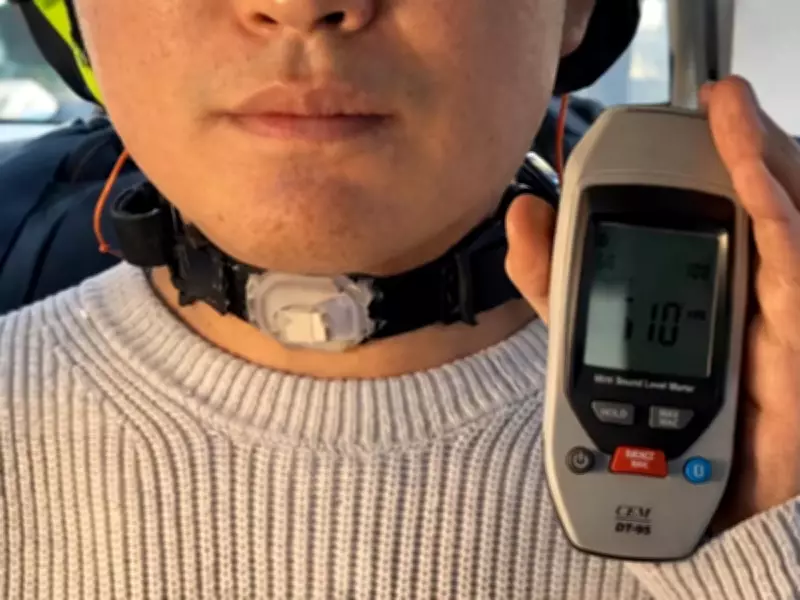
That is why scientists from the Pohang University of Science and Technology (POSTECH) have taken a radical new approach. Instead of trying to block background noise like traditional microphones, they have chosen to bypass the ears entirely. They have created an elastic silicone neckband equipped with tiny cameras and motion sensors that track the subtle ripples of muscle and skin around the wearer's neck.
The technology is based on the fact that during silent speech and mouthing words, our internal anatomy moves in predictable patterns. By feeding these movements into an artificial intelligence model, the computer can "see" what you are saying. The research, published in the Journal of Cyborg and Bionic Systems, demonstrates how AI can decode speech from muscle movements with astounding precision.
The appeal of this method lies in its ability to ignore everything around it. Since it does not listen to sound, a jet engine could be screaming inches away, and the neckband would still transmit a perfectly clear message. This effectively creates a secure, quiet communication channel that is oblivious to the audio environment. This innovation promises to restore voices for those unable to speak and enhance communication safety across various industries, heralding a silent future for audio.
Restoring Voices and Protecting Workers
Although the concept of a microphone-less future sounds like science fiction, the primary motive behind this project is deeply humane. Professor Sung-Min Park and his colleagues at POSTECH developed the neckband to help people who cannot speak due to surgery or illness, such as laryngectomy patients.
One of the most striking aspects of this AI-driven device is its ability to replicate the person's voice. Previously, speech synthesis often sounded harsh and robotic. This new technology employs "Deep Face"-style techniques to learn the unique tones and character of a voice. According to the research, it takes only ten minutes for the AI to master sounding like the user.
Outside the medical field, the implications for the general public are enormous. Imagine having conversations in a noisy library without whispering, or communicating in complete silence during a covert operation. The study shows that in an environment with 90 dB of white noise—roughly the level of a lawnmower or a loud factory—the neckband provided the same signal quality and outperformed conventional electronic sensors.
There are still obstacles to overcome. The device currently achieves the highest accuracy when the user is seated, and its vocabulary is limited to a set of words. If the wearer turns their head or walks, accuracy may decrease. However, as AI models improve at filtering out "body noise" such as walking and other vibrations, these teething problems will likely disappear.

A World Without Background Noise
The transition from traditional microphones to AI-powered wearables will be gradual. We probably will not throw away our headphones tomorrow. But we are witnessing the beginnings of a future where "noise" is a relic of the past. If a neckband can transform muscle movements into an exact digital representation of your voice, the need for a diaphragm that captures air vibrations is eliminated.
This change also addresses the cost of sound production. Instead of investing thousands of dollars to soundproof a room, a creator can simply wear a band around their neck. The AI handles all the "performance," ensuring clear and professional audio quality regardless of the recording location.
As we look to the coming years, the lines between our bodily movements and the digital world will continue to blur. The research currently underway in South Korea is a testament that AI is not just an aid for writing emails or creating images; it is now an essential part of how we interact with the physical world.
We are entering an era where "speaking" no longer requires breath or sound. All it takes is a conscious thought, the subtle and quiet movement of muscles, captured by a thin piece of silicone, and an extremely clever algorithm. The candlestick phone and the legendary podcaster microphone had a good run; the future of talking will be very, very silent.
About the Author
The TOI Science Desk is an inquisitive team of journalists, ceaselessly delving into the realms of discovery to curate a captivating collection of news, features, and articles from the vast and ever-evolving world of science for the readers of The Times of India. Consider them your scientific companion, delivering a daily dose of wonder and enlightenment. Whether it is the intricacies of genetic engineering, the marvels of space exploration, or the latest in artificial intelligence, the TOI Science Desk ensures you stay connected to the pulse of the scientific world. They are not just reporters; they are storytellers of scientific narratives, committed to demystifying the intricacies of science and making it accessible and engaging for readers of all backgrounds.