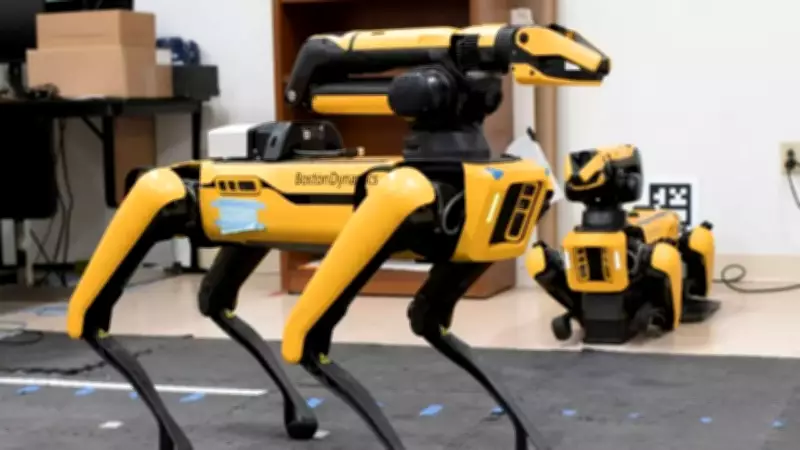
Robots Master Object Location in Cluttered Environments by Learning From Canine Companions
In a groundbreaking development at the intersection of robotics and animal behavior, researchers from Brown University have successfully trained robots to locate specific items in messy, disorganized spaces by studying how dogs interpret human intention. This innovative approach addresses a fundamental challenge in robotics where machines often struggle to accurately identify what humans are pointing to when multiple objects are present in the vicinity.
The Challenge of Pointing Interpretation in Robotics
When humans want to direct attention to an object, we naturally point toward it. For robots programmed to follow simple coordinates, this task becomes straightforward in controlled environments. However, in real-world scenarios with numerous items clustered together, robots frequently become confused by ambiguous gestures. The core problem lies in the limited geometric data available when a robot only has a human's finger position to work with, leading to frequent misinterpretations.
Canine Collaboration: How Dogs Map Human Intent
The research team made a crucial breakthrough by collaborating with the Brown Dog Lab to analyze how dogs successfully interpret human pointing gestures. Dogs possess a remarkable ability to understand human intention by creating what researchers call a pointing cone - a spatial probability field derived from multiple human cues rather than a single coordinate.

This canine technique involves analyzing three key elements simultaneously:
- The direction of a person's eye gaze
- The angle of the elbow joint
- The alignment and position of the wrist
By synthesizing these geometric relationships, dogs create a probabilistic understanding of where a human intends them to look, rather than relying on potentially misleading single-point coordinates.
The LEGS-POMDP Framework: Artificial Intelligence That Navigates Like a Dog
The research team translated this canine methodology into a sophisticated robotic system called LEGS-POMDP (Locally Estimated Geometric Structure - Partially Observable Markov Decision Process). According to lead researcher Ivy He, this framework represents a significant advancement in how robots handle partial observable challenges in cluttered environments.
The system enables robots to perform reasoning despite uncertainties through several key mechanisms:
- When ambiguity exists about which object a human is indicating, the robot analyzes the human's gaze direction and limb positions
- Instead of relying on potentially inaccurate single coordinates, the robot calculates positional probabilities within a defined pointing cone
- The system allows robots to determine optimal observation positions when direct line-of-sight to target objects is obstructed
Impressive Results and Practical Applications
In rigorous testing, robots utilizing the LEGS-POMDP framework achieved a remarkable 89% success rate in locating specific items when humans combined verbal commands with pointing gestures. This represents a substantial improvement over previous robotic systems that struggled with gesture interpretation in cluttered environments.
The research, presented at the International Conference on Human-Robot Interaction in Edinburgh, Scotland, aims to bridge the gap between controlled laboratory settings and real-world applications. The ultimate goal is to transition robots from structured environments to typical residential and clinical buildings where messy and disorganized surroundings are the norm.
From Laboratory to Living Room: The Future of Assistive Robotics
By imitating the natural collaborative dynamics between humans and dogs, researchers hypothesize they can develop more effective robotic assistants capable of functioning in intricate, unstructured environments. This technology holds particular promise for applications in homes, hospitals, and other settings where robots need to retrieve specific objects amid chaotic surroundings.

The Brown University team's work represents a fascinating convergence of animal behavior studies and artificial intelligence development, demonstrating how biological systems can inform technological solutions to complex problems in human-robot interaction.