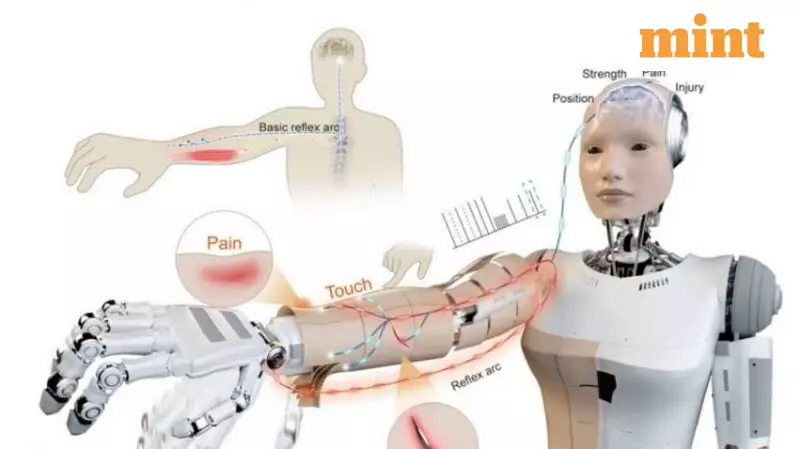
In a major leap for robotics, a team of researchers in Hong Kong has engineered an advanced electronic skin that grants humanoid robots the ability to sense touch and react to pain much like humans do. This innovation promises to make robots safer and more responsive in dynamic environments.
Artificial Skin Mimics Human Nervous System
The breakthrough comes from a team led by engineer Yuyu Gao at the City University of Hong Kong. They have developed a neuromorphic robotic skin that replicates how the human nervous system processes sensations. Detailed in the prestigious journal PNAS, this technology moves beyond simple pressure measurement. It translates physical contact into electrical signals that closely resemble the neural pulses in our bodies.
These signals vary in intensity based on the force applied. This allows a robot equipped with this skin to distinguish between a gentle tap, like a handshake, and a potentially damaging impact, such as a collision. This nuanced sensing is a foundational step towards more natural and safe human-robot interaction.

How the Robotic Reflex System Works
The electronic skin's design is ingeniously layered, with four functional strata, each mimicking a part of biological nerve pathways. For routine, gentle contact, signals travel to the robot's central processor for analysis, aiding in tasks like precise object manipulation.
The critical innovation lies in its pain response mechanism. When pressure exceeds a pre-set pain threshold, the system triggers a reflex. Instead of sending the signal through the slower central processor, the skin generates a high-voltage pulse that travels directly to the robot's motors.
This direct pathway bypasses the main computer, triggering an immediate withdrawal response. It's akin to a human instinctively pulling their hand away from a hot stove. This dramatically slashes reaction time, helping to prevent damage to both the robot and anything—or anyone—around it.
Self-Awareness and Easy Repairs
Another smart feature is the skin's built-in health monitoring. Each sensor module constantly emits a tiny 'I'm okay' signal. If the skin gets torn or cut, that signal at the damaged location stops. This allows the robot to quickly pinpoint the exact spot that needs attention.
While the material cannot heal itself like biological skin, repairs are remarkably simple. The skin is constructed from magnetic modules that snap together like building blocks. If a section is damaged, it can be detached and a new one slapped on in seconds, without needing to replace the entire surface.
This research marks a significant step towards creating robots that are not only more intelligent but also more physically aware and resilient. By integrating a human-like sense of touch and pain, robots can operate more safely alongside people in homes, hospitals, and workplaces.