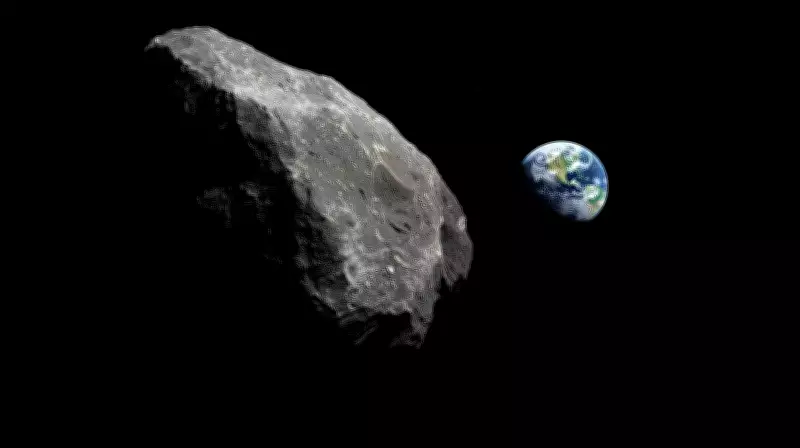
Scientists Test Real Meteorite at CERN to Improve Asteroid Deflection Strategies
Planetary defense research has long operated in a realm where theoretical models and imaginative scenarios dominate, with limited opportunities to test actual materials under realistic conditions. A groundbreaking new study is shifting this paradigm by examining how genuine asteroid material behaves when subjected to extreme energy levels similar to those proposed for deflection missions.
Groundbreaking Experiment with Real Meteorite
The research, detailed in the study "Dynamical development of strength and stability of asteroid material under 440 GeV proton beam irradiation," was conducted at CERN using a fragment of the Campo del Cielo iron meteorite that fell in Argentina thousands of years ago. This marks one of the first times scientists have been able to observe how actual asteroid material responds to the kind of energy that might be used to deflect a threatening space rock.
Researchers exposed the meteorite sample to repeated pulses of ultra-high-energy proton beams from one of the world's most powerful particle accelerators. Each pulse delivered intense heat and stress within fractions of a second, simulating conditions that could occur during asteroid deflection attempts.

Innovative Non-Destructive Testing Method
Rather than simply smashing the meteorite fragment, the scientific team employed sophisticated laser measurement techniques to monitor the sample's response. This innovative approach allowed them to track tiny surface movements and deformations without destroying the valuable extraterrestrial material, something that had not been possible in previous experiments.
The key question driving this research was whether asteroids would break apart or remain intact when subjected to deflection efforts. This distinction carries enormous implications for planetary defense strategies, as fragmentation could potentially increase risk by creating multiple impact threats, while controlled movement would offer a safer approach.
Surprising Material Behavior Under Stress
At lower energy levels, researchers observed that the meteorite vibrated and returned to its original state. As the intensity increased, the material briefly entered a phase of plastic deformation where its internal structure shifted temporarily. Crucially, the sample did not crack or fracture during this process.
Following this plastic deformation phase, the meteorite actually became harder and resumed stable behavior. The stress had rearranged its crystal structure, creating defects that ultimately strengthened the metal. While this phenomenon is known in metallurgy, it had never been directly observed in asteroid material under such extreme conditions.
Resolving Longstanding Scientific Contradictions
For years, planetary scientists have struggled to explain why meteorites appear strong in laboratory tests yet often break up easily when entering Earth's atmosphere. This new research suggests both perspectives were incomplete. Small-scale laboratory tests measure local strength, while actual asteroids behave as bulk objects with complex internal boundaries and delayed stress movement.
This complexity makes asteroids appear weaker initially but also enables them to absorb energy and adapt rather than fail completely. The study provides experimental evidence that some asteroid materials are tougher and more adaptable than previously assumed.
Implications for Planetary Defense Strategies
The findings strongly support deflection approaches over destruction methods for planetary defense. Blowing up an asteroid risks spreading debris across a wider area, potentially creating multiple impact threats. Deflection strategies rely on applying a small but timely push to alter an asteroid's orbit long before it approaches Earth.
The research demonstrates that metal-rich asteroids can absorb more energy than expected without disintegrating. This discovery increases confidence in various deflection methods, including:

- Kinetic impactors that would collide with asteroids to alter their trajectories
- Nuclear stand-off explosions designed to provide momentum without fragmentation
- Particle-based approaches that transfer momentum gradually rather than causing sudden breakage
A Quiet Revolution in Planetary Defense Thinking
While the research doesn't claim all asteroids behave identically—many are rocky rather than metallic—it offers rare experimental evidence that reduces uncertainty in planetary defense planning. The implications unfold gradually but represent a significant shift from speculative guesswork toward evidence-based observation.
This work narrows longstanding uncertainties about how tough asteroids really are and makes controlled intervention strategies feel less speculative. As planetary defense moves from imagination toward concrete data, such experiments provide crucial building blocks for protecting Earth from potential asteroid impacts.