PGI Chandigarh Unveils AR Navigation App to Tackle Hospital Maze
Navigating the bustling corridors of the Postgraduate Institute of Medical Education and Research (PGI) in Chandigarh has long been compared to traversing a complex labyrinth. With a staggering daily influx of over 10,000 patients and their attendants, the hospital is now embracing patient-centric technology to address a persistent issue: the challenge of getting lost within its vast campus.
Innovative Solution Born from Pandemic Chaos
The genesis of this initiative traces back to the turmoil of the COVID-19 pandemic. Dr. Anurag Ramavat, leading a team from the ENT department, conceived the idea when patients struggled to find their way amid reduced staff availability. "Even as a faculty member, I found this place to be a maze when I first joined," she recalled, highlighting the universal difficulty in orientation.
How PGI Margdarshan Works
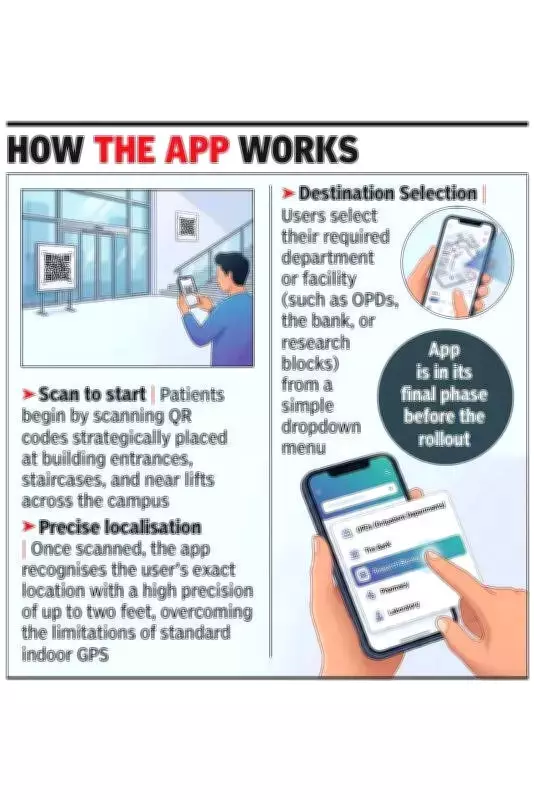
Unlike conventional mapping services, the PGI Margdarshan app leverages Augmented Reality and 3D imagery to achieve precision down to just two feet. Here’s a step-by-step breakdown of its functionality:

- Scan to Start: Patients initiate the process by scanning QR codes strategically positioned at building entrances, staircases, and near lifts across the campus.
- Precise Localisation: Upon scanning, the app accurately pinpoints the user's location, overcoming the limitations of standard indoor GPS systems.
- Destination Selection: Users choose their required department or facility—such as OPDs, the bank, or research blocks—from a straightforward dropdown menu.
- Guided Navigation: The app displays 3D pictures of the actual surroundings with superimposed arrows, directing users exactly where to turn. To ensure inclusivity, it supports voice commands in Hindi, English, and Punjabi.
Addressing Practical Challenges
With 10,000 individuals entering daily, the strain on security guards and hospital staff to provide directions is immense. PGI Margdarshan aims to alleviate this directional fatigue and reduce the anxiety patients experience when rushing to time-sensitive appointments.
To bridge the digital divide, PGI plans to deploy Sarthi volunteers during the initial rollout, assisting those unfamiliar with QR codes. The app has been optimised to run smoothly on basic Android smartphones, ensuring accessibility without the need for high-end hardware.
Security and Sustainability Measures
The mapping is strictly confined to patient-centric zones, covering areas like OPDs, the bank, the market, and research blocks. For security reasons, faculty offices and private research labs remain unmapped and restricted. To ensure durability, the current laminated QR codes will soon be replaced with tamper-proof PVC versions, guaranteeing the system's longevity.
Funding and Future Prospects
This innovation is backed by a Rs 42 lakh grant from the Indian Council of Medical Research. Dr. Ramavat confirmed that the team has already secured the trademark and copyright for the app, marking a significant milestone in indigenous medical-tech innovation at the institute. The full-scale launch is anticipated within the next month, potentially setting a new standard for hospital infrastructure across India.
By integrating cutting-edge technology with practical solutions, PGI Chandigarh is poised to transform the patient experience, making navigation seamless and stress-free in one of the country's busiest medical facilities.