Oxford Astronomers Uncover a Fiery 'Magma Ocean' World in Deep Space
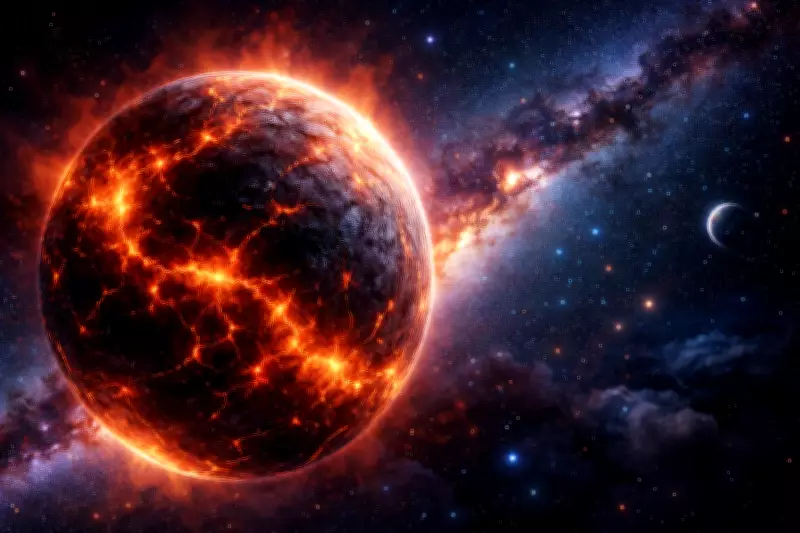
In a groundbreaking discovery that reshapes our understanding of distant planets, astronomers led by the University of Oxford have identified a small, rocky world located 35 light-years from Earth, named L 98-59 d. This exoplanet, part of a closely clustered system orbiting a small star, defies conventional categorisation by featuring a mantle of molten rock thousands of kilometers deep, creating what scientists describe as a permanent "magma ocean."
A World of Molten Rock and Sulphur-Rich Atmosphere
L 98-59 d is slightly larger than Earth but bears little resemblance to our home planet. Instead of a cool, solid crust, its surface temperatures soar up to 1,900 °C, maintaining the rock in a "mushy" state. The mantle is composed primarily of molten silicate, similar to Earth's volcanic material, forming a global ocean of magma that extends nearly to the core. Unlike Earth, which cooled over billions of years to develop tectonic plates, this exoplanet has remained molten for a significant portion of its lifetime.
The presence of sulphur plays a crucial role in this alien environment. The molten interior retains vast amounts of sulphur, which slowly rises to the surface as hydrogen sulphide gas, contributing to a thick atmosphere dominated by hydrogen. This unique combination of a sulphur-rich lava world and a pungent atmosphere is not found anywhere in our Solar System, marking L 98-59 d as a distinct class of exoplanet.

How Scientists Unraveled the Planet's Secrets
Astronomers did not directly observe the interior of L 98-59 d. Instead, they employed sophisticated computer models that integrate telescope observations with simulations of planetary interiors and atmospheres. By analyzing data from observatories like the James Webb Space Telescope and tracing the planet's evolution from its formation nearly five billion years ago, the team inferred the existence of the magma ocean.
Lead author Dr. Harrison Nicholls from Oxford's Department of Physics explained in the study published in Nature Astronomy that this discovery "suggests that the categories astronomers currently use to describe small planets may be too simple." Co-author Professor Raymond Pierrehumbert added that the research demonstrates how "computer models can uncover the hidden interior of a planet we will never visit," transforming remote data into vivid images of molten rock oceans and exotic chemistry.
Implications for Exoplanet Classification and Habitability
This finding challenges the traditional classification of "rocky" or "super-Earth" planets. A planet like L 98-59 d may share Earth's mass and size but be permanently molten beneath a thick atmosphere, making it far less habitable than it might appear. The detection of sulphur-based gases, including hydrogen sulphide with its characteristic rotten egg smell, could indicate the prevalence of similar "pungent planets" across the galaxy.
Planetary physicist Dr. Richard Chatterjee from the University of Leeds and Oxford noted, "We need more observations to determine just how common these 'pungent planets' really are, but the initial findings suggest they could be surprisingly common." This revelation urges caution in the search for habitable worlds, as a seemingly Earth-like planet could, in reality, be a scorching molten sulphur world unsuitable for life as we know it.
Future Directions in Space Science
The research, detailed in Nature Astronomy, signals a shift towards more precise terminology for exoplanets, moving from basic descriptors like "rocky" to physics-based labels such as "magma ocean worlds" and "sulphur lava planets." This advancement enables scientists to better interpret telescope data and plan targeted follow-up observations, enhancing our comprehension of diverse planetary systems.
For the public, the concept of a world with a continent-scale ocean of glowing rock and a thick, pungent atmosphere highlights the alien yet familiar nature of exoplanets. The discovery of L 98-59 d is not merely a scientific milestone; it fosters a more nuanced dialogue about what constitutes another Earth and expands our imagination of the universe's possibilities.