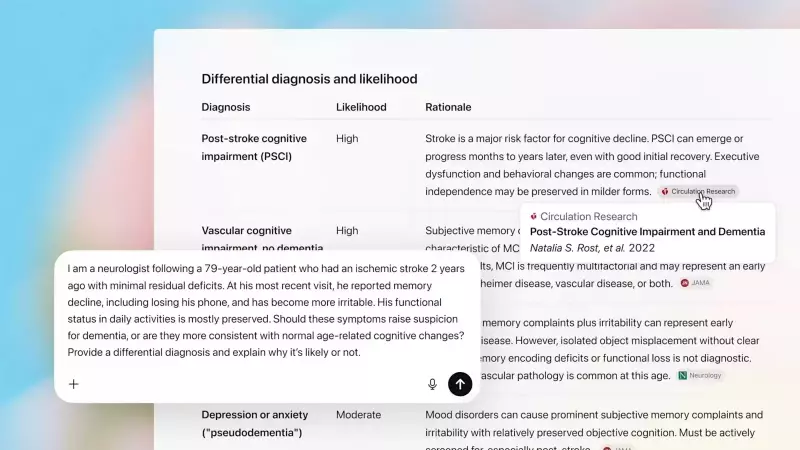
In a significant move to bridge the gap between artificial intelligence and clinical practice, OpenAI, the creator of ChatGPT, announced on 8 January a dedicated suite of products for the healthcare sector. Dubbed "OpenAI for Healthcare," this initiative is designed to assist medical organizations in delivering consistent, high-quality patient care while rigorously supporting compliance with the United States' Health Insurance Portability and Accountability Act (HIPAA) of 1996.
What Does OpenAI's Healthcare Suite Include?
The suite comprises two core offerings: ChatGPT for Healthcare and the OpenAI API. The company asserts that both products are built with enterprise-grade security and are fully compliant with HIPAA regulations, which mandate strict privacy and disclosure protections for patient health information.
OpenAI stated that advances in its AI models have significantly enhanced the technology's capability to support real-world clinical and administrative workloads. This includes helping clinicians personalize patient care using the latest medical evidence. The new suite aims to provide a secure foundation so that healthcare teams can leverage these powerful tools to improve and standardize care delivery.

ChatGPT for Healthcare: Reducing Administrative Burden
The first product, ChatGPT for Healthcare, is engineered to support careful, evidence-based clinical reasoning while reducing the administrative burden on medical staff. This tool has been made available across the United States and is already being implemented by several prominent institutions. Early adopters include AdventHealth, Baylor Scott & White Health, Boston Children’s Hospital, Cedars-Sinai Medical Center, HCA Healthcare, Memorial Sloan Kettering Cancer Center, Stanford Medicine Children’s Health, and the University of California, San Francisco (UCSF).
OpenAI API: Powering Broader Healthcare Ecosystems
The second offering is the OpenAI API, which serves as the underlying software engine to power broader healthcare ecosystems and applications. OpenAI revealed that thousands of organizations have already configured this API for HIPAA-compliant use. Notable companies leveraging it include Abridge, Ambience, and EliseAI.
Why HIPAA Compliance is a Game-Changer
HIPAA is a critical U.S. federal law that establishes standards for protecting sensitive patient health information from being disclosed without the patient's consent or knowledge. Its importance in the healthcare landscape cannot be overstated.
The act's Privacy Rule governs the use and disclosure of individuals' Protected Health Information (PHI), granting patients rights to understand and control how their data is used. It strikes a balance between protecting individual privacy and allowing necessary information flow to promote high-quality care and public health. Permitted disclosures without individual authorization include scenarios for treatment, payment, healthcare operations, public health activities, and law enforcement, among other nationally prioritized purposes.
How OpenAI Ensures HIPAA Compliance
OpenAI has implemented several robust measures to ensure its products meet stringent HIPAA requirements. Clients gain access to a centralized workspace with role-based access controls and organization-wide user management, providing essential governance and visibility.
Crucially, patient data and PHI remain under the control of the healthcare organization. OpenAI supports this with options for data residency, detailed audit logs, and customer-managed encryption keys. Furthermore, the company enters into a Business Associate Agreement (BAA) with its healthcare clients, a formal contract required under HIPAA when a vendor handles PHI. In a key privacy commitment, OpenAI confirmed that content shared with ChatGPT for Healthcare is not used to train its AI models.
This launch marks a pivotal step in integrating advanced, secure AI into the healthcare mainstream, promising to enhance both clinical decision-making and operational efficiency while upholding the highest standards of patient data privacy.