OpenAI CEO's Awkward Stage Moment at India AI Summit Goes Viral
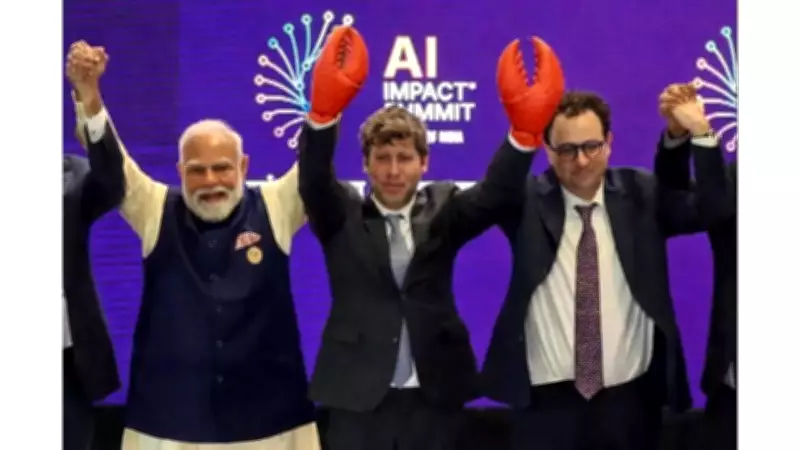
OpenAI CEO Sam Altman experienced a brief but noticeable moment of confusion on stage during the India AI Impact Summit 2026. While posing for a photograph with Prime Minister Narendra Modi and other prominent technology leaders, Altman appeared momentarily disoriented, a clip that quickly circulated across social media platforms.
Subtle Tensions and a Memorable Photograph
Observant users noted that Altman and Anthropic CEO Dario Amodei, standing adjacent to each other, did not join hands during the group photo, unlike several other executives present. This minor detail fueled online speculation about the underlying dynamics between the two competing artificial intelligence giants.
The official ChatGPT account on X later amplified the discussion by sharing an edited version of the viral image. In this playful alteration, the raised hands of the figures were replaced with oversized red lobster claws. While the post carried no caption, it was widely interpreted as a clever nod to OpenAI's recent strategic acquisition.

OpenAI's Strategic Move: The OpenClaw Hiring
The meme coincides with OpenAI's announcement of hiring Peter Steinberger, the creator of the viral AI agent framework OpenClaw. Sam Altman revealed the acquisition on X, stating Steinberger will "drive the next generation of personal agents." This move is considered one of OpenAI's most strategically significant talent acquisitions this year.
OpenClaw is an open-source tool enabling users to deploy AI agents for tasks like managing emails, booking travel, coordinating calendars, and interacting on a specialized bot network named MoltBook. Following the hire, the project will transition into a foundation model with ongoing support from OpenAI.
"The future is going to be extremely multi-agent," Altman wrote, emphasizing the company's vision. "We expect this will quickly become core to our product offerings." The acquisition grants OpenAI immediate access to a mature open-source ecosystem, a globally distributed agent platform, and a founder who chose collaboration over building a standalone company.
Deepening Rivalry with Anthropic
The timing of ChatGPT's meme post is particularly noteworthy given recent developments. Anthropic recently secured a massive $30 billion funding round and aired a Super Bowl advertisement that took direct aim at OpenAI. The competition has evolved beyond mere model performance benchmarks.
The focus has shifted decisively towards capturing developer mindshare, constructing robust AI agent ecosystems, and influencing the foundational development of autonomous AI systems. This strategic battleground explains the significance of the OpenClaw framework.
OpenClaw's Rapid Rise and Subsequent Friction
OpenClaw experienced explosive growth, amassing approximately 145,000 stars on GitHub, supporting around 1.5 million active agents, and attracting roughly 2 million weekly visitors in a remarkably short timeframe. Critically, the project recommended Anthropic's Claude Opus 4.5 as its default model, driving significant adoption for the rival firm.
Tensions escalated when Anthropic, without prior warning, restricted OpenClaw's API access in early January 2026, disrupting its core functionality. This was followed by a legal notice from Anthropic contesting the project's original name, "Clawdbot," for its similarity to "Claude." The founder complied, changing the name during an early-morning call.
Reports indicate that during this transition period, the project's online accounts were briefly compromised by scammers who executed a cryptocurrency fraud scheme, adding further complexity to the situation.
The viral moment from the India AI Summit, therefore, serves as a symbolic snapshot of the intense and multifaceted rivalry currently defining the frontier of artificial intelligence development, where corporate strategy, talent wars, and ecosystem control are as critical as technological innovation.