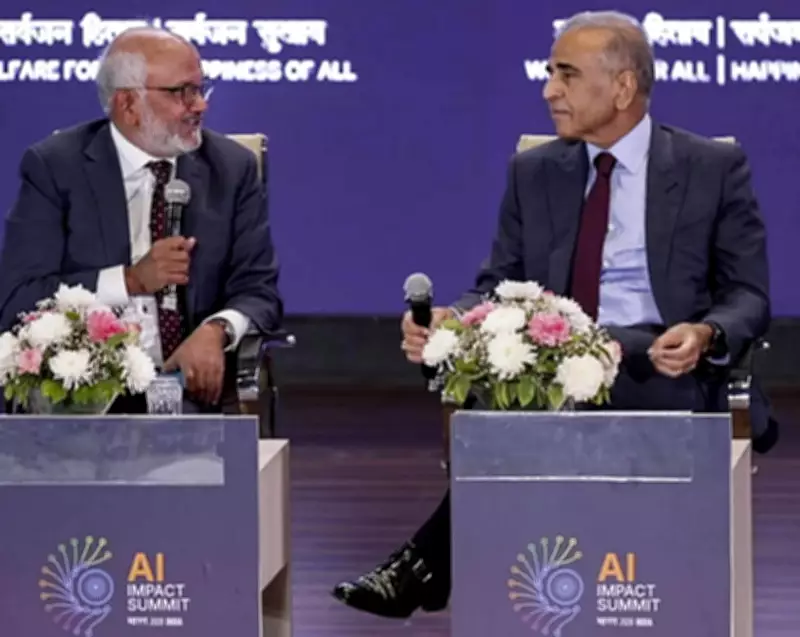
Industry Leaders Champion Open and Trusted AI at India AI Impact Summit
In a significant development at the India AI Impact Summit held in New Delhi, prominent industry leaders have issued a strong call for artificial intelligence to remain open, trusted, and accessible on a global scale. They warned against the concentration of AI power in the hands of a few, emphasizing India's crucial potential role in shaping international norms and standards for this transformative technology.
Sunil Mittal Highlights AI Integration in Telecom and Beyond
Sunil Mittal, the founder and chairman of Bharti Enterprises, provided concrete examples of AI's growing centrality in business operations. "From our company's standpoint, AI is becoming a really integral part of how we operate, serve customers, and build our networks," he stated during the summit. Mittal elaborated that this integration is not limited to telecommunications but extends to vital sectors poised for transformation.
He specifically pointed to healthcare, education, and medical sciences as areas that "will flourish on the back of this" technological advancement. His comments underscore a vision where AI acts as a foundational driver for innovation and efficiency across multiple industries, contributing to broader economic and social development.

Shantanu Narayen on India's Leadership and AI Authenticity
Shantanu Narayen, chairman and CEO of Adobe, projected India's emergence as a global AI powerhouse based on its user base. "Given that the number of people using AI in India will be greater than anywhere else in the world in a few years, the leadership role India can play is significant," Narayen asserted.
He clarified that this leadership extends beyond mere adoption to critical governance areas: "not just in what these models mean, but in how we think about data, privacy, security, and trust." This positions India at the forefront of establishing ethical frameworks for AI deployment.
A paramount concern raised by Narayen is the challenge of authenticity in the era of generative AI. He proposed a technical solution to combat misinformation: "I want every piece of information that's produced to carry provenance and a watermark so that people can clearly distinguish what is real from what is fake." This call for built-in verification mechanisms highlights the urgent need for trust and transparency as AI-generated content becomes more prevalent.
The Path Forward for Global AI Governance
The summit discussions collectively outlined several key imperatives for the future of AI:
- Preventing Concentration: Ensuring AI development and benefits are not monopolized by a limited number of entities or nations.
- Building Trust: Establishing robust standards for data privacy, security, and output authenticity to foster public confidence.
- Ensuring Accessibility: Making AI tools and their advantages available to a broad, global audience.
- Leveraging India's Role: Utilizing India's massive upcoming user base and democratic values to influence ethical global AI policies.
The India AI Impact Summit has thus served as a pivotal platform, uniting industry visionaries to advocate for an AI future that is inclusive, secure, and guided by principles that benefit humanity as a whole. The emphasis on India's strategic position suggests the country is poised to be a key architect in the global AI landscape.