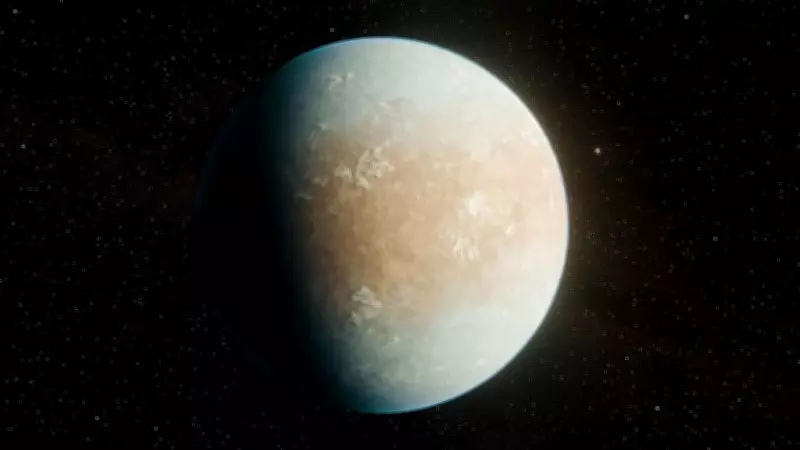
Potential Earth-Sized Exoplanet Emerges from Archived NASA Telescope Data
In a remarkable discovery from archival space data, scientists analyzing observations from NASA's retired Kepler space telescope have identified what appears to be a rocky world slightly larger than Earth orbiting a nearby star. This celestial body, designated HD 137010 b, occupies a position remarkably similar to Earth's orbital distance from our Sun, though the conditions on this distant world may be far from hospitable.
A Candidate Planet in the Habitable Zone
The potential planet sits near the outer edge of what astronomers term the habitable zone—the region around a star where conditions might allow for liquid water to exist on a planetary surface. This placement immediately sparks interest in the long-debated possibility of extraterrestrial liquid water, yet simultaneously raises significant doubts about the planet's actual environment.
The host star, HD 137010, differs substantially from our Sun. Classified as a K-type dwarf, this star is notably cooler, dimmer, and less luminous than our solar system's central star. Consequently, a planet orbiting at an Earth-like distance from such a star would receive dramatically less energy. Preliminary calculations suggest HD 137010 b might receive less than one-third of the solar energy that Earth enjoys from sunlight.

Discovery from Historical Data
This finding originates from continued analysis of data collected during Kepler's K2 mission phase, which concluded in 2018. Although the telescope itself ceased operations years ago, its extensive archive continues to yield new scientific insights. Researchers identified this candidate through detection of a single transit event—a brief, measurable dip in starlight caused when a planet passes directly between its host star and our telescopes.
It is crucial to note that HD 137010 b remains classified as a candidate rather than a confirmed planet. This distinction carries significant weight in astronomical circles. Typically, astronomers require multiple, regularly spaced transit observations to confidently distinguish a genuine planetary signal from statistical anomalies or stellar noise. Nevertheless, even a single, clear transit signal can provide valuable preliminary information about a potential world.
Orbital Characteristics and Environmental Conditions
Based on transit duration and stellar modeling, the research team estimates that HD 137010 b completes one orbit approximately every Earth year. This characteristic makes it somewhat unusual among known exoplanets, many of which orbit their stars in mere days or weeks.
The reduced energy input from its cooler star has profound implications for surface conditions. Without a substantial greenhouse effect to trap heat, the planet's surface temperature could plummet to extreme lows. Current estimates suggest temperatures around minus 90 degrees Fahrenheit—slightly colder than the average temperature on Mars.
These temperature projections come with considerable uncertainty, as they depend on assumptions about the planet's atmospheric composition, reflectivity, and internal heat sources. They underscore a fundamental truth of exoplanet science: Earth-like size and orbital distance do not automatically guarantee Earth-like environmental conditions.
The Habitability Question
Despite the frigid outlook, researchers maintain a cautiously open perspective. Their models indicate that if HD 137010 b possesses a thick atmosphere rich in carbon dioxide or other greenhouse gases, it could potentially retain sufficient heat to support liquid water on its surface.
Using these atmospheric models, the team calculates approximately a 40% probability that the planet resides within the conservative definition of the habitable zone, and a 51% chance it falls within a broader, more optimistic habitable zone definition. Simultaneously, they acknowledge nearly equal odds that the planet exists entirely outside habitable zone boundaries. The balance remains delicate and uncertain.

Challenges of Confirmation and Future Study
Confirming HD 137010 b as a genuine planet presents substantial challenges. With an orbital period approaching one Earth year, transit events occur infrequently. Missing a single observation opportunity means waiting many months for the next potential detection window.
Future observational efforts may utilize NASA's Transiting Exoplanet Survey Satellite (TESS) mission or the European Space Agency's CHEOPS satellite, both specifically designed to study planets orbiting nearby bright stars. Should these attempts prove unsuccessful, definitive confirmation might need to await the deployment of more powerful next-generation space telescopes.
One compelling aspect of this discovery is the system's relative proximity. Located approximately 146 light-years away and orbiting a star sufficiently bright for detailed measurements, HD 137010 b could become a valuable target for intensive study if its planetary status is confirmed.
A Scientific Maybe
For now, HD 137010 b occupies that quiet scientific category of possibilities—neither a definitive second Earth nor an unequivocally lifeless world. Instead, it exemplifies the meticulous, gradual pace of modern planetary science, where even a single shadow crossing a distant star can initiate years of further investigation or fade quietly back into the vastness of astronomical data archives.
This discovery serves as a powerful reminder that retired scientific missions continue to provide value long after their operational lifetimes, and that our search for potentially habitable worlds requires both patience and persistent analysis of all available evidence.